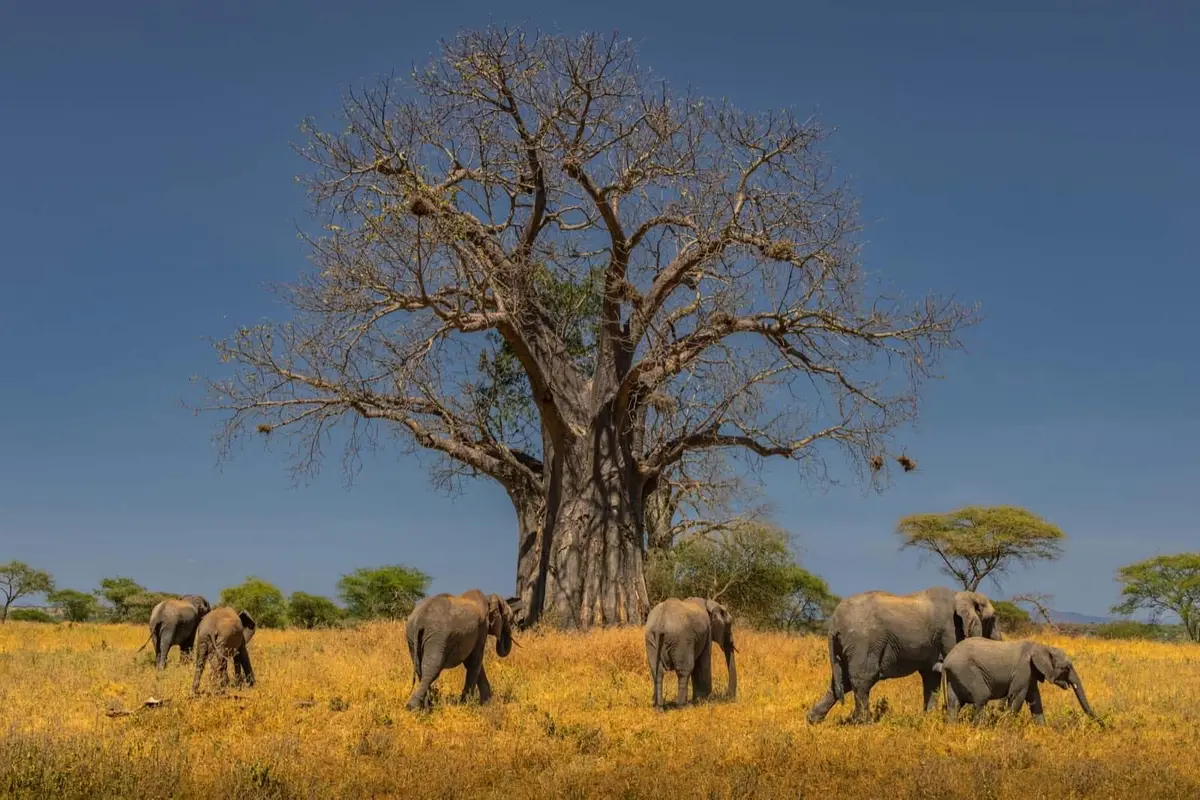
Ruaha National Park
A remote park in southern Tanzania for travellers who have seen the migration and would now like a quieter safari.
Plan a Safari HereSee it on the Northern Circuit mapPark imagery
About Ruaha National Park
Ruaha lies in the south-central highlands of Tanzania, well away from the northern circuit that most visitors follow, and most guests arrive by air. Coastal Aviation's daily flight from Dar es Salaam to Msembe takes approximately 2.5 hours, and the flight from Arusha takes closer to two hours with a stop. The nearest town is Iringa, 112 kilometres from the park boundary. This distance is the main reason Ruaha stays quiet, as the park receives around 20,000 visitors a year despite being 40 percent larger than the Serengeti, which receives 350,000.
The Great Ruaha River and its sand tributaries, the Mwagusi and the Mdonya, are the centre of the park's wildlife. In the dry season from June to October, as smaller water sources dry up across the park, the animals gather along the rivers, and elephants dig in the dry sand for water below the surface. Repeat visitors describe this more often than any other Ruaha scene. Heavy poaching between 2009 and 2014 reduced the elephant population from around 30,000 to roughly 8,272, and as a result many of the surviving females have no tusks. According to the Southern Tanzania Elephant Program's 2021 survey, the Ruaha-Rungwa ecosystem now holds around 15,000 elephants. Buffalo herds of more than 500 are common, and lion prides of 15 to 25 animals, among the largest recorded in Africa, hold territories along the river.
Ruaha is one of three remaining African landscapes with more than 500 adult wild dogs, together with KAZA in Botswana and Zimbabwe and the Selous-Niassa corridor to the east. The Ruaha Carnivore Project, founded in 2009 by Dr. Amy Dickman and now part of Lion Landscapes, has recorded 37 packs across the wider Ruaha-Rungwa-Katavi landscape. Sightings cannot be guaranteed, but the June to July denning season near the Mwagusi is the most predictable time. Wild dogs succeed in around 80 percent of their hunts, compared with 25 to 30 percent for lions, and a pack hunting on open ground is one of the fastest predator events in Africa. Most guests who see one rate it above any river crossing they have watched.
The landscape is where Ruaha differs most from northern Tanzania. The park lies where the East African and Southern African biomes meet, so it holds species that are not found in the Serengeti or Ngorongoro. Greater and lesser kudu can be seen together, sable and roan antelope are resident, and the Ruaha red-billed hornbill is found only in this park. More than 570 bird species have been recorded, including migrants from Europe and Asia in the green season. Guides in Ruaha also check the hollow trunks of baobab trees, where leopards shelter from the afternoon heat, behaviour that is particular to this park.
Walking safaris are permitted throughout the park. Operators such as Jongomero and Kichaka Expeditions run multi-day fly-camping trips into the remote eastern sections, where there are no vehicle tracks, which is something the Serengeti cannot offer. In the main areas the safari is still vehicle-based, but because there are so few vehicles a game drive here feels very different. Sightings are rarely shared with other vehicles, and some animals still react to a vehicle because they are less used to them than animals in the north.
Wildlife in Ruaha
African Wild Dog
Ruaha is one of three African landscapes with more than 500 adult wild dogs (WCS Tanzania), and 37 packs have been recorded in the Ruaha-Rungwa ecosystem. The June to July denning season near the Mwagusi is the most predictable time for sightings, and their hunting success is around 80%.
Lion
Ruaha holds around 10% of Africa's lions, in prides of 15 to 25 animals, among the largest recorded anywhere. Their territories follow the Great Ruaha River and the Mwagusi sand river.
Elephant
The Ruaha-Rungwa ecosystem holds roughly 15,000 elephants, recovering from a poaching crash that left 8,272 in 2014, and many females have no tusks as a result. Herds of several hundred gather on the river in the dry season, and elephants digging for water in the dry sand riverbeds are the best-known sight in Ruaha.
Greater Kudu
Greater kudu are not found in northern Tanzania. The males carry spiralling horns over a metre long, and the species is present all year in the mixed woodland and miombo forest.
Sable Antelope
The males are jet black with curved, scimitar-shaped horns. Sable are not found on the northern circuit, but they are seen reliably in the park's open grassland during the dry season.
Ruaha Red-Billed Hornbill
This hornbill is found only in Ruaha National Park. It is one of more than 570 bird species recorded here, including European and Asian migrants in the green season.
Walking Safaris
Walking safaris in Ruaha are more flexible than on the northern circuit. The park allows multi-day walking safaris, including remote fly-camping in the eastern sections where there are no vehicle tracks. Operators such as Kichaka Expeditions, which has three tents and specialist guide Andrew 'Moli' Molinaro, and Jongomero have built their reputations on walking safaris.
On foot, the guides read tracks in the sand riverbeds, find kills by watching vultures half a kilometre away, and use the wind and the terrain to approach animals. An elephant reacts very differently to people on foot than to a Land Cruiser, which is a large part of the appeal.
Walking safaris are not suitable for families with young children and require a reasonable level of fitness. Most properties, including Mwagusi and Jongomero, offer half-day walks from a vehicle-based camp. Multi-day routes need to be booked in advance, and we will discuss them with you when planning the trip.
Camps in Ruaha
The choice of camp is more important in Ruaha than on the northern circuit, because the park is very large and the properties are far apart, so your camp's location decides which part of the park you can reach most easily.
Jongomero Camp has eight luxury tents in the remote south of the park, on a private concession. It is now run by the LABA Hotel Group following a renovation, rates are around $997 per person per night in 2026/27, and it is open from 1 June to 1 March. Its southern position gives access to country with a Southern African character, with greater kudu, sable and different predator behaviour from the riverine areas further north.
Mwagusi Safari Camp, on the Mwagusi sand river, is the camp that safari specialists most often name first. It is run by its owner, Chris Fox, and is widely considered the best location in the park, mainly because wild dog packs den near Mwagusi in June and July.
Kokoko Camp (Asilia) has replaced Kwihala, which has closed permanently, although many websites still list Kwihala. Kokoko is in a similar position and has newer facilities.
Jabali Ridge (Asilia) opened in 2017 with eight suites on a kopje, an infinity pool and a spa, and suits guests who want a high level of comfort in a remote setting.
Ruaha River Lodge (Foxes Safari Camps) is the oldest property in the park and the only one open all year, with stone-and-thatch bandas on the Great Ruaha River. It is also the most economical option and the only choice for travel in April and May.
Kigelia Ruaha (Nomad Tanzania), Mdonya Old River Camp, Ikuka Safari Camp and Kichaka Expeditions are the other camps we would consider.
Best Time to Visit Ruaha
| Months | Weather | Wildlife | Crowds |
|---|---|---|---|
| Jun-Aug | Dry and warm by day, with cold nights that can fall to 10°C. Ruaha has a single rainy season, so it is drier than the northern circuit at the same time of year. | Excellent, as the wildlife gathers along the rivers. This is the wild dog denning season and the most predictable time of year to see them. | Low |
| Sep-Oct | Dry and hot, at 30-35°C in the middle of the day. Elephants dig for water in the sand riverbeds. | The dry-season concentration is at its peak, with the largest elephant herds, buffalo herds of 500 or more and the most predator activity. | Low to moderate |
| Nov-Dec | The rains usually begin around mid-December and the park turns green. Birding is at its best as European and Asian migrants arrive. | The wildlife spreads out as water returns, and wild dog pups begin to travel with the packs. Conditions for photography are excellent. | Very low |
| Jan-Feb | Green season, hot and humid, with the rains increasing through February. | The wildlife is spread out but present, many species are breeding and the birding is exceptional. | Very low, and most camps offer discounted rates. |
| Mar-May | Ruaha has one long rainy season, while the north has two. March and April are the wettest months, with approximately 250mm of rain in April, and Coastal Aviation suspends its Ruaha flights from mid-March to the end of May. | Most camps are closed, but Ruaha River Lodge stays open all year and offers significant discounts. | Most operators are closed, and Ruaha River Lodge stays open. |
Frequently Asked Questions
What makes Ruaha National Park unique?
Ruaha differs from Tanzania's other parks in three ways. It lies where the East African and Southern African ecosystems meet, so it holds species that are not found on the northern circuit, including greater kudu, lesser kudu, sable antelope, roan antelope and the Ruaha red-billed hornbill, which lives nowhere else. It is also one of only three African landscapes with more than 500 adult wild dogs, together with KAZA and Selous-Niassa, and the packs here are actively tracked. Finally, walking safaris are permitted, including multi-day routes into remote areas without vehicle tracks, whereas walking is not allowed in the core zone of the Serengeti.
Is Ruaha worth visiting? How does it compare to the Serengeti?
The two parks are difficult to compare directly. The Serengeti has the Great Migration, 350,000 visitors a year, extensive infrastructure and the largest wildlife spectacle in Africa. Ruaha has around 20,000 visitors a year in a park 40% larger, no hot-air balloons, and long drives without another vehicle in sight. The animals in Ruaha are less used to vehicles, so encounters feel different from the north, and many repeat visitors say Ruaha made their earlier safaris seem crowded. If this is your first Tanzania safari and you want to see the migration, we recommend starting with the northern circuit. If you have already done the northern circuit, Ruaha is a very good next step.
Are there cheetahs in Ruaha?
Yes, there are cheetahs in Ruaha, although they are seen less often than in the Serengeti or Ndutu. The open grassland suits them, but much of the park is mixed woodland, which is less suitable cheetah habitat. Sightings are possible, particularly on the open plains near the Mwagusi, but wild dog, lion and elephant are the animals Ruaha is known for.
How do you get to Ruaha National Park?
Most visitors fly to Msembe Airstrip inside the park. Coastal Aviation flies daily from Dar es Salaam, a journey of approximately 2.5 hours, with fares from around $430 one way. Auric Air flies between the Serengeti and Ruaha three times a week, on Monday, Thursday and Saturday, which allows the northern and southern circuits to be combined in one trip. Coastal Aviation suspends its Ruaha flights from mid-March to the end of May because of the long rains. It is also possible to drive from Iringa, 112 km and approximately three hours on rough dirt roads, in a 4WD vehicle, and Ruaha River Lodge is the only camp that caters specifically for self-drive guests.
How many days do I need in Ruaha?
We recommend at least three full days, and five if possible. Ruaha suits a longer stay at one or two camps better than a quick circuit with several moves, as it gives the guides time to explore the same areas repeatedly. This matters most for wild dogs, which are not seen every day, and a guide who follows the radio network over several days improves your chances considerably. Guests on three-day visits often wish they had stayed longer.
Are wild dogs guaranteed in Ruaha?
No, wild dog sightings cannot be guaranteed anywhere in Africa, and visitors' experiences vary widely, as some see a pack on the first day while others spend seven days without a sighting. Ruaha does, however, offer the best chance in East Africa. The June to July denning season, when the packs return to the same den each day, is the most predictable time, and guides share pack locations over the radio network with researchers from the Ruaha Carnivore Project. A stay of at least three full days improves the chances considerably.
Can you combine Ruaha with the northern circuit?
Yes. Auric Air's flight between the Serengeti and Ruaha, three times a week, connects the two directly, so you can combine the northern and southern circuits without going through Dar es Salaam. We recommend allowing at least 12 days in total to do both well. Ruaha and Zanzibar also combine well, with a flight from Dar es Salaam to Ruaha for four or five nights, and then a flight to Zanzibar either via Dar es Salaam or directly with Coastal Aviation. Please send us your dates and we will plan the route.
What is the best lodge in Ruaha?
Safari specialists most often name Mwagusi Safari Camp first for its overall experience and location. Jongomero is the leading luxury option, with eight tents on a private concession in the remote south at around $997 per person per night. Jabali Ridge (Asilia) has the best facilities for guests who want hotel-standard comfort in the bush, Ruaha River Lodge (Foxes) is the most economical and the only property open all year, and Kichaka Expeditions is the best choice if walking safaris are your priority. Please note that Kwihala Camp has closed permanently and has been replaced by Kokoko Camp (Asilia), although many websites still list Kwihala.
Safari Itineraries Including Ruaha