Ndutu Calving Season
The Ndutu calving season is when the wildebeest of the Great Migration give birth on the short-grass plains around Lake Ndutu and Lake Masek, on the southern edge of the Serengeti. The herds settle here from December, the first calves arrive in late December, and the peak runs from late January to early March, with thousands of births a day.
Plan a Calving Safari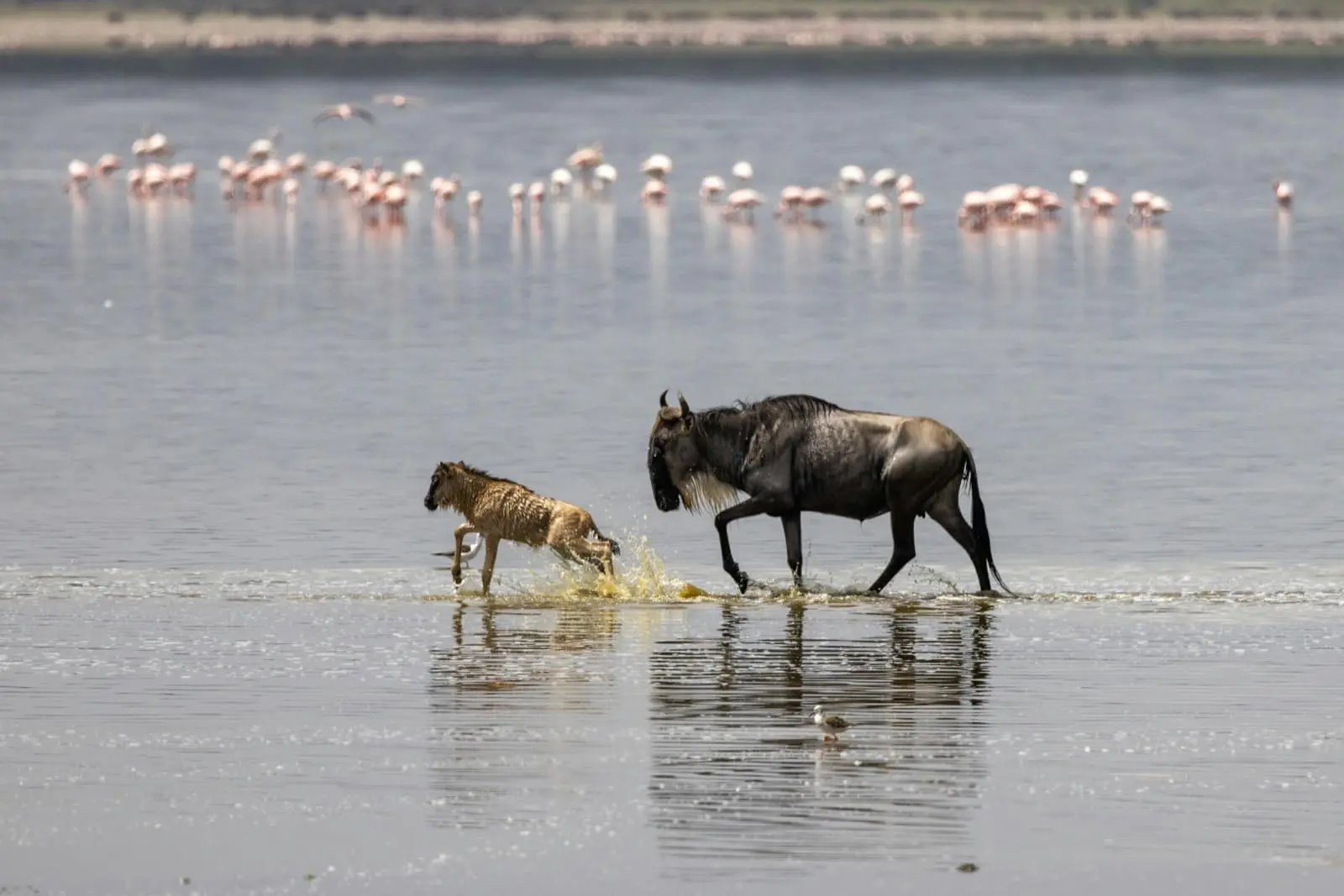
- Calving peak
- Late January to early March
- Herds on the plains
- December to March
- Where
- Lake Ndutu and Lake Masek, Ngorongoro Conservation Area
- Nights we suggest
- 3 at least, 4 to 5 if you can
When is the Ndutu calving season?
The wildebeest come south after the short rains of November and December turn the Ndutu plains green, and they stay while the short grass lasts. The calving builds through January, peaks from late January to early March, and tails off as the long rains approach in March, when the herds begin moving north-west towards the central Serengeti.
The dates follow the rain rather than the calendar, so they move by a week or two from one year to the next. For that reason we plan Ndutu nights inside the peak window and keep the rest of the route flexible.
| When | What happens on the plains |
|---|---|
| December | The herds settle on the short-grass plains around Ndutu, and the first calves arrive in the second half of the month. |
| January | Births rise week by week, and the predators gather around the herds. |
| Late January to early March | The peak: thousands of calves born every day and the most predator activity of the year. February is the busiest month for vehicles and camps. |
| Mid to late March | Births slow, the long rains approach and the herds start drifting north-west. |
Where the calving happens
The calving grounds are the open short-grass plains around Lake Ndutu and Lake Masek, in the north-west corner of the Ngorongoro Conservation Area. The boundary with Serengeti National Park is unfenced, and the herds spread across it onto the southern Serengeti plains.
The short grass on these volcanic plains is what the nursing cows need, and it lets the herds see predators coming. Where the herds stand on any morning depends on the latest rain, so your guide follows them rather than heading to a fixed spot.
Predators during the calving
Lions, spotted hyenas and cheetahs hunt on the calving plains, and black-backed jackals and vultures follow every kill. A wildebeest calf can stand and walk within minutes of birth, but the first hours are when it is most exposed.
The grass is short and the plains are open, so hunts that would be hidden elsewhere happen in plain view, often in the soft light of early morning. Ndutu's lions and cheetahs live here all year; in the calving months the herds come to them.
Ndutu or the central Serengeti in calving season?
For the calving, base yourself at Ndutu. The central Serengeti is a fine second stop for its resident big cats, but from late December to March the herds are on the southern plains, not around Seronera.
| Ndutu | Central Serengeti (Seronera) | |
|---|---|---|
| Herds, Jan to Mar | On the plains around the camps | Usually far to the south, at Ndutu |
| Managed by | Ngorongoro Conservation Area Authority | Tanzania National Parks (TANAPA) |
| Entry fee, per person per day | $70.80 (conservation area) | $82.60 (national park) |
| Between the two | About 2 hours as a transfer by road | |
Game drives from Ndutu often cross into the national park, and then both entry fees apply that day. Current figures for every park are on our Tanzania park fees page.
How to get to Ndutu
Ndutu is reached from Arusha through Karatu and over the Ngorongoro highlands, and it sits close enough to the crater and the central Serengeti to combine both on one trip. Ndutu also has an airstrip, so one leg can be flown.
Times are our best estimates and grow in the wet. See all routes on our drive times page.
Where to stay for the calving
Three properties at Ndutu stay open all year: Ndutu Safari Lodge, with cottages on the shore of Lake Ndutu, Lake Ndutu Luxury Tented Lodge and Masek Tented Lodge. For the calving months they are joined by seasonal mobile camps around Lake Ndutu and Lake Masek, which usually open from December to March or April and then move to the northern Serengeti.
February is the hardest month of the year to book at Ndutu. The best-placed camps have only a handful of tents, so we recommend booking six to nine months ahead for February, and late January or early March if you are booking later.
Every camp, its season and its fee zone is on our Ndutu accommodation guide.
Calving season or the Mara River crossings?
Both are part of the same migration. The calving runs for weeks on open plains, while each river crossing is a single event that cannot be promised on a given day.
| Ndutu calving season | Mara River crossings | |
|---|---|---|
| When | December to March, with the peak from late January to early March | July to October in the northern Serengeti |
| Base | Ndutu, on the Ngorongoro Conservation Area and Serengeti border | Kogatende, northern Serengeti |
| What you see | Births and predators hunting on open plains, through the day | Herds crossing a river with crocodiles, with long waits between crossings |
| From (Comfort tier, 6 sharing) | $2,640 pp | $4,680 pp |
For the crossings, see our Mara River crossing guide and the Great Migration Safari. For the herds month by month, see the Great Migration month by month.
Ndutu calving season questions
When is the Ndutu calving season in 2027?
The herds are usually settled on the Ndutu plains by late December 2026, the first calves are born from late December, and the peak of the 2027 calving runs from late January to early March 2027. From mid-March the long rains approach and the herds start drifting north-west. The timing follows the short rains, so it shifts a little from year to year, which is why we plan Ndutu nights inside the peak rather than around a single date.
When is the peak of the wildebeest calving?
Late January to early March. Births are tightly synchronised: a study in the journal Nature found that the Serengeti herds produce about 80 percent of their calves within a three-week period. At the height of the season NASA's Earth Observatory and BBC Wildlife Magazine both put the figure at around 8,000 calves a day, and National Geographic puts the total at about half a million calves a year. February sits in the middle of the peak and is the month most travellers try to book, so late January and early March are the easier dates to find space.
Where exactly does the calving happen?
On the open short-grass plains around Lake Ndutu and Lake Masek, in the north-west corner of the Ngorongoro Conservation Area, and across the unfenced boundary onto the southern plains of Serengeti National Park. Where the herds stand on a given day depends on recent rain, so your guide follows the herds each morning rather than driving to a fixed spot.
Which predators can you see during the calving?
Lions, spotted hyenas and cheetahs all hunt on the calving plains, and black-backed jackals and vultures follow every kill. The grass is short and the country is open, so hunts that would be hidden in longer grass happen in plain view. Ndutu's lions and cheetahs live in the area all year, and in calving season the herds come to them.
Should I stay at Ndutu or in the central Serengeti for the calving?
Stay at Ndutu for the calving. From late December to March the herds are on the southern plains, and a camp at Ndutu puts you among them at first light. The central Serengeti around Seronera is about 2 hours from Ndutu by road, and it is a good second stop for its resident big cats, but in these months the herds are rarely there. Ndutu sits in the Ngorongoro Conservation Area, so its fees differ from the Serengeti's; the table on this page sets them side by side.
How do you get to Ndutu from Arusha?
By road it takes about 6 to 6.5 hours, plus time at Loduare Gate: about 3 hours from Arusha to Karatu, then about 3 hours 15 minutes from Karatu to Ndutu, over the Ngorongoro highlands and down onto the plains. Our calving itinerary breaks the journey with a night in Karatu on the way in and a night on the crater rim on the way out. Ndutu also has an airstrip, so one leg can be flown if you would rather not drive both ways.
Which lodges and camps are open at Ndutu in calving season?
Three properties stay open all year: Ndutu Safari Lodge on the shore of Lake Ndutu, Lake Ndutu Luxury Tented Lodge and Masek Tented Lodge. On top of these, seasonal mobile camps open around Lake Ndutu and Lake Masek for the calving months, usually from December to March or April, and then move north. Our Ndutu accommodation page lists every camp with its season and park fee zone.
How far ahead should I book a calving season safari?
Six to nine months ahead for February, and earlier for the best-placed small camps. The season is short and the camps close to the plains have only a handful of tents, so February dates are usually the first to go. If you are booking later than that, late January and early March fall inside the same peak and usually have more space.
How many nights do you need at Ndutu?
At least three nights, and four to five if you can. The herds move with the rain, and extra nights give your guide time to find the herds and the predators following them. Our calving itinerary pairs four nights at Ndutu with a day in the Ngorongoro Crater.
What are the park fees at Ndutu?
Ndutu lies inside the Ngorongoro Conservation Area, so the conservation area's fees apply: $70.80 per person per day for entry, plus a nightly concession fee for the camp. Game drives that cross into Serengeti National Park add the Serengeti entry fee of $82.60 per person per day. Our park fees page has every current figure, and our quotes show the fees as separate lines.
Sources and Maintenance
Where these figures come from
The calving follows the rain, so the weeks move a little each year.
- Peak window: Saleh Safaris guiding team, field experience at Ndutu (set 26 November 2026)
- NASA Earth Observatory, 'Circling the Serengeti' (herds at Ndutu December to March, around 8,000 calves a day) (published 9 September 2019)
- BBC Wildlife Magazine (Discover Wildlife), wildebeest calving ('as many as 8,000 calves can be born in a single day' in February; up to 500,000 over two to three weeks) (read 26 November 2026)
- Sinclair, A.R.E. (1977), 'Lunar cycle and timing of mating season in Serengeti wildebeest', Nature 267: 832-833 (about 80 percent of calves born within a three-week period) (peer-reviewed)
- Booking lead time (six to nine months ahead for February): Saleh Safaris experience booking Ndutu camps (set 26 November 2026)
- National Geographic, wildebeest and the Great Migration (about half a million calves a year) (published 28 April 2026)
- Ngorongoro Conservation Area and TANAPA fees, from our park fees page (see /tanzania-park-fees)
- Drive times: Saleh Safaris route notes (estimates, conditions vary)
Plan your calving season safari
We run private calving season safaris from Arusha, with our own vehicle and guide. Send us your dates and we will put together an itinerary.
- Calving Season Safari itinerary
- Or message us on WhatsApp +255 742 789 292
Plan Your Dream Safari
Free quote · No commitment · Reply within 24h
Your enquiry is free and without obligation.