Ngorongoro Crater
The world's largest intact volcanic caldera, where around 25,000 animals live on the crater floor all year.
Plan a Safari HereSee it on the Northern Circuit map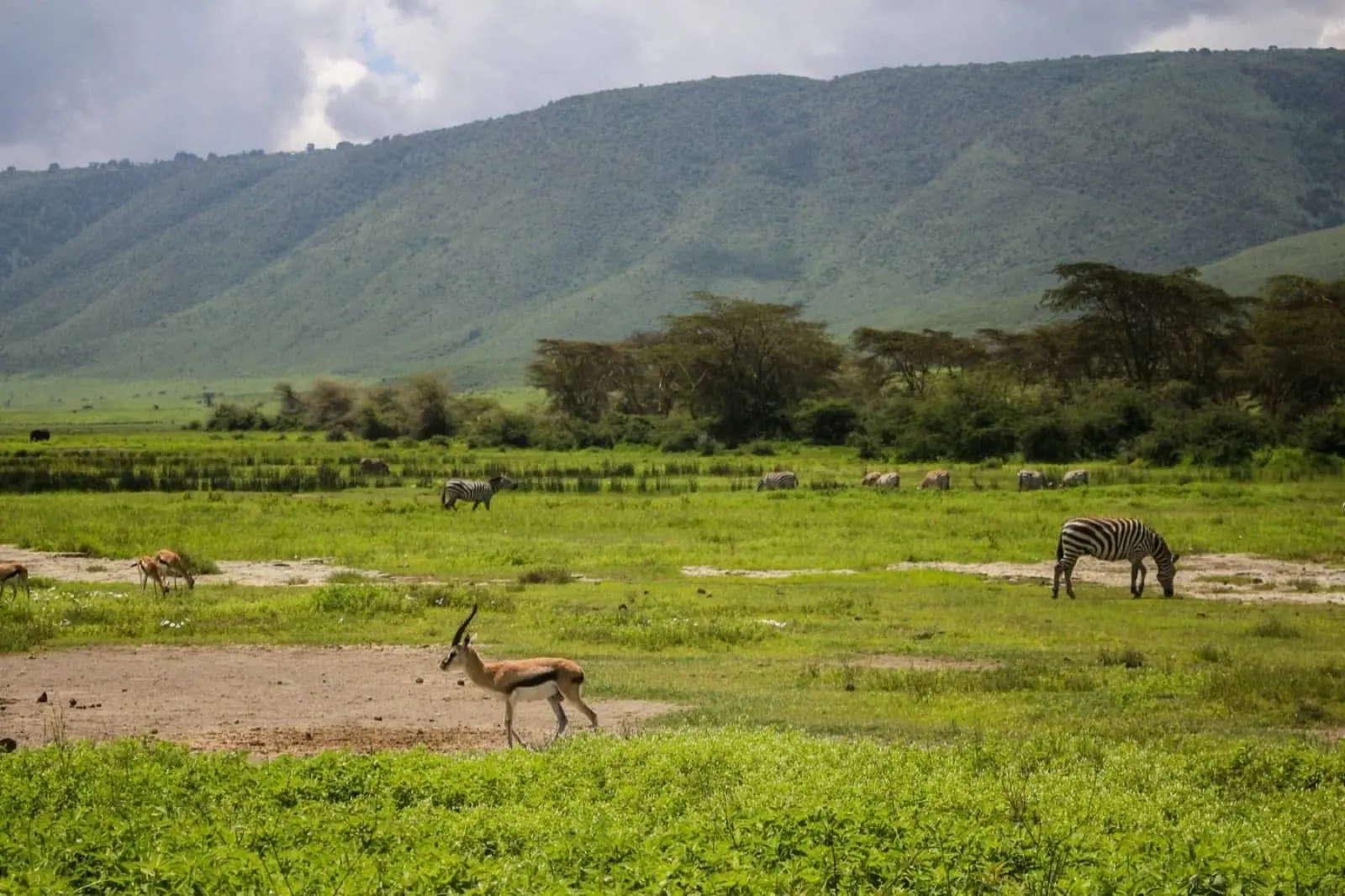
About Ngorongoro Crater
Many websites refer to Ngorongoro National Park, but the Ngorongoro Crater lies inside the Ngorongoro Conservation Area (NCA), a different category of protected area managed by the Ngorongoro Conservation Area Authority. Tanzania's national parks have no human settlement or livestock, whereas roughly 20,000 Maasai pastoralists live and graze their cattle within the NCA, as they have for centuries. The rules for visitors are also different, starting with the fees, which are set by the Ngorongoro Conservation Area Authority rather than by TANAPA.
The crater formed between two and three million years ago, when a large volcano, thought to have been as tall as Kilimanjaro, erupted and collapsed inwards. The caldera it left is 610 metres deep and about 20 kilometres across, with a floor of 260 square kilometres. The rim lies at 2,286 metres above sea level and the floor at roughly 1,800 metres, so at 6:00am on the rim the temperature is usually around 8°C with wind, while by midday on the floor it reaches 22-28°C. Many visitors forget to bring a fleece, and we recommend dressing in layers.
Approximately 25,000 large mammals live on the crater floor all year without migrating. The walls are steep enough that most animals stay, and the crater provides everything they need, with fresh water from the Munge Stream and Ngoitokitok Springs, open short-grass plains, swamps at Mandusi and Gorigor, and acacia forest in the Lerai sector in the south. The lion density is among the highest in Africa. Poaching reduced the black rhino population from 108 in the mid-1960s to 13 by 1993, and under the Ngorongoro Rhino Protection Programme it has recovered to more than 50, according to the conservation area authority in 2018. Giraffe and impala are both absent, because the crater walls are impassable for giraffe and the floor lacks the open woodland and particular trees that both species need.
UNESCO inscribed the NCA as a Natural World Heritage Site in 1979 and added Mixed status, which recognises both its natural and its cultural importance, in 2010. The cultural listing reflects the area around the crater as much as the crater itself. Laetoli, approximately 45 km to the southwest, has hominid footprints preserved in volcanic ash 3.6 million years ago, the oldest confirmed footprints of an animal walking upright. Olduvai Gorge, roughly 45 km northwest by road, is where Mary Leakey found the skull of Paranthropus boisei in 1959. The NCA is therefore one of the most important archaeological landscapes in the world as well as a wildlife area, with the crater at its centre.
A day in the crater is organised differently from a day in the Serengeti. Vehicles go down with a permit on one of two roads, Seneto on the west side or Lemala on the east. The only place where you can leave the vehicle is the designated picnic area at Ngoitokitok Springs, which has a hippo pool right next to it. In the peak season, vehicles gather in the mornings near Mandusi Swamp, where most lions are seen, while the far western floor near Gorigor Swamp, the best area for rhino, has far less traffic.
Wildlife in Ngorongoro
Black Rhino
The population has recovered from 13 in 1993 to more than 50, according to the conservation area authority in 2018. Rhinos are seen most often at Gorigor Swamp in the morning, usually at a distance of 300-500m, so binoculars are essential.
Lion
The crater has one of the densest lion populations in Africa, with large prides holding territories across the open grassland and around Mandusi Swamp. The crater lions are largely isolated from the wider Serengeti ecosystem.
Elephant
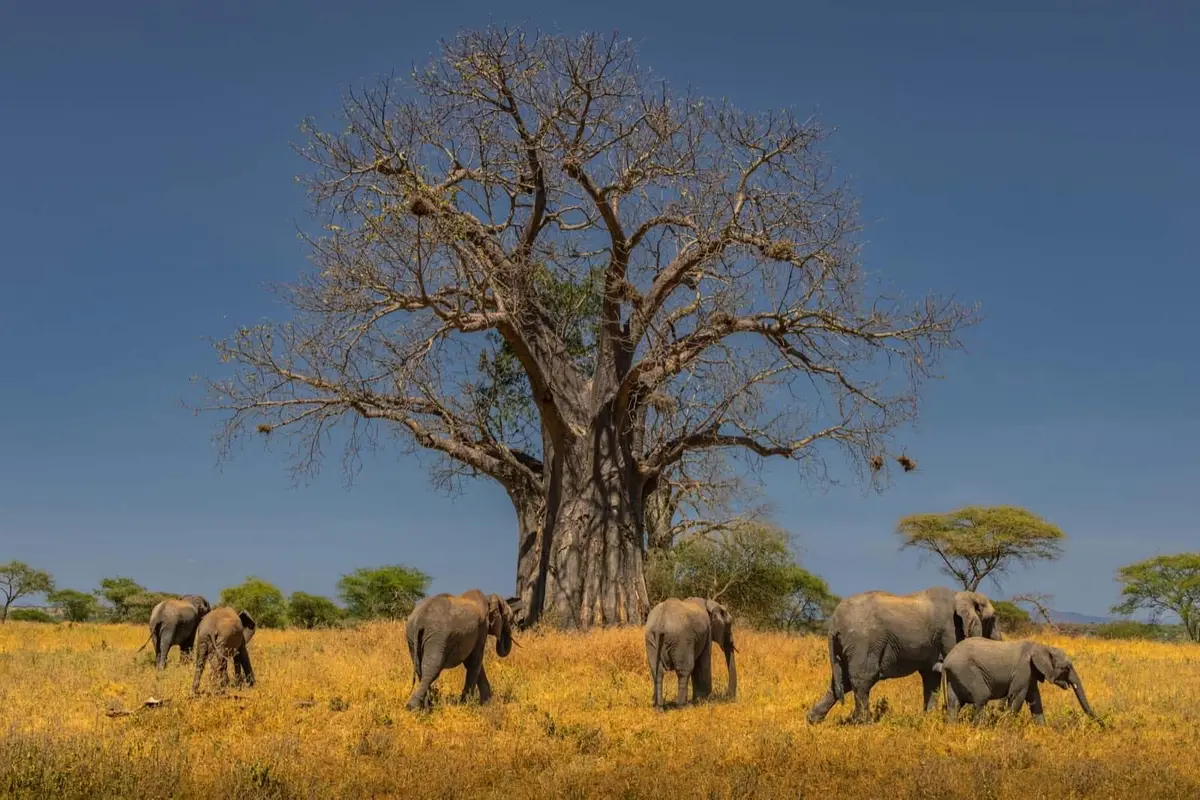
Only bull elephants live in the crater, as the walls are too steep for family groups with calves. The bulls shelter in the Lerai Forest in the middle of the day and move onto the open plains in the early morning and late afternoon.
Flamingo
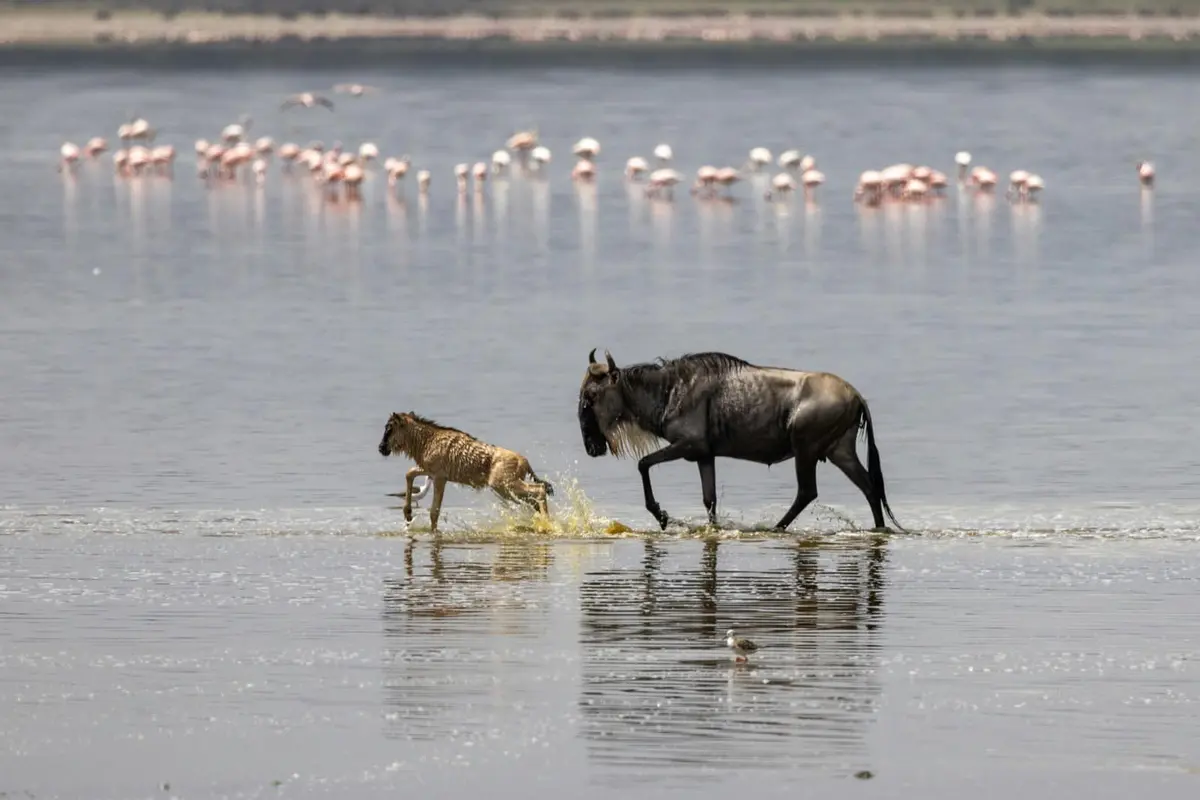
Thousands of lesser flamingos gather on the alkaline Lake Magadi on the western crater floor. Their numbers vary with the water level, and January to March is generally the most reliable time.
Hippo
Hippos live permanently in the Munge Stream and in the Hippo Pool near Mandusi Swamp. Ngoitokitok Springs, the only authorised stop, has a hippo pool right beside the picnic area.
Spotted Hyena
Hyenas are one of the crater's most underrated species. Clans number 33 to 72 animals, and they are active hunters that make more kills each day on the crater floor than the lions.
Habitat by Habitat: What Lives Where
The crater floor has six distinct habitats, each with different species at different times of day, so it helps to know which areas to prioritise.
The Lerai Forest in the south is a dense stand of yellow-fever acacias where bull elephants shelter in the middle of the day. The elephants come down from the crater walls in the morning and move into the shade of the forest as the floor heats up. Baboons and vervet monkeys live in the canopy, and leopards have been recorded here, although sightings are rare.
Gorigor Swamp, on the western floor, is the best place in the crater for black rhino, and rangers follow individual animals here most mornings. The ground is open and flat, so you can see across 400-500 metres, and binoculars are essential.
Mandusi Swamp, next to Gorigor, is lion country. The resident prides keep to the edges of the swamp, and the first two hours after the descent offer the best chance of predator activity. This is also where most vehicles gather in the peak season.
Lake Magadi is the alkaline lake in the western part of the crater, and it turns pink with lesser flamingos when the water level is right. In the dry season the water level falls and the flamingos move elsewhere, so January to March is generally the most reliable time to see the lake at its best.
Ngoitokitok Springs, in the southeast, is the only place where vehicles may stop and passengers may get out. A permanent hippo pool lies right beside it, and we recommend allowing around 20 minutes here rather than a short stop.
The Munge Stream crosses the northern floor and supports waterbirds all year, with crowned cranes, kori bustards, grey-crowned cranes and egrets seen reliably in every season.
The Black Rhino Recovery
The Ngorongoro black rhino population is one of the most closely watched in African conservation and one of the continent's few real recovery stories.
In the mid-1960s the crater held around 108 rhinos, and by 1993 poaching had reduced them to 13. The decline was rapid, well documented and very nearly irreversible.
Since then the recovery has been slow but steady. In 2018 the Chief Conservator of the Ngorongoro Conservation Area Authority reported more than 50 rhinos in the conservation area. The Ngorongoro Rhino Protection Programme, run in partnership with the Frankfurt Zoological Society, has operated without a break since the 1990s, and its rangers know each animal by name and injury history.
The recovery has been possible because the crater is enclosed. The single gated descent road, staffed by rangers, made the large-scale commercial poaching that destroyed rhino populations across East Africa in the 1970s and 1980s much harder to carry out here. The species is still critically endangered, but Ngorongoro is one of the main reasons that black rhinos survive in East Africa in their current numbers.
A Day on the Crater Floor
Most safaris recommend an early-morning descent into the crater, and a typical full day runs as follows.
6:00am: Loduare Gate opens. If you are staying on the rim, your guide will collect you before this for the drive to the descent road.
6:30am: Descend by the Seneto Descent Road. The drive down takes 20-30 minutes on a steep, single-track dirt road through montane forest, and there is often morning mist on the crater walls in the wet season.
7:00am to 12:00pm: Game drive on the crater floor. Lions are most active in the first two hours after the descent, and predator activity drops considerably after 10am as the animals look for shade.
12:30pm: Picnic lunch at Ngoitokitok Springs, the only authorised stop, with a packed lunch from the rim lodge. The hippos in the pool beside the picnic area are reliable and sometimes come very close.
1:00pm to 3:30pm: Second game drive, with the Lerai Forest and Lake Magadi as the priorities for the afternoon. Elephants become more active again after 2pm as the bulls leave the shade of the forest.
3:30pm: Ascent via the Lemala Road begins. The NCAA closes the crater exit gates at 6:00pm, so vehicles head up in the late afternoon.
In the peak season from July to October, vehicles gather in the mornings near Mandusi Swamp, where lions are seen most reliably, while the western floor near Gorigor and the far edges of Lake Magadi have far less traffic. Your guide will choose the route on the day.
The Descent Roads
Two roads lead down into the crater, and the one you take affects what you see first.
The Seneto Descent Road, on the western wall, is the usual morning route down and, like all the crater gates, opens at 6:00am according to the NCAA. It crosses Maasai grazing land on the upper rim, passes through the cloud forest and reaches the floor near the open grassland and Mandusi Swamp, which is good for early sightings of lion and wildebeest. Most vehicles use Seneto in the morning.
The Lemala Ascent Road, on the eastern wall, is the usual route out. It passes close to the Lerai Forest before climbing to the rim, so a late-afternoon exit via Lemala can include elephants in the forest. Some guides reverse the usual route, going down via Lemala and up via Seneto, and your guide will recommend the best option for the current wildlife movements.
A third road, the Lerai Ascent on the southern wall, is used occasionally and gives a different view of the forest. The usual arrangement, down via Seneto and up via Lemala, keeps the traffic moving in one direction.
Rim Viewpoints
Four viewpoints on the crater rim look down on the 260-square-kilometre floor from different angles, and the time of day matters as much as the location.
Heroes' Point, on the eastern rim near the Lemala approach road, is the most photogenic at sunrise, when the floor is still in shadow and the crater walls catch the first light from the east. The best time is between 6:00am and 7:30am, after which the light becomes flat.
Crater Viewpoint is the main stopping point used by most tour vehicles. It is wide and easy to reach, but it is usually crowded by 9:00am, so we recommend visiting at first light.
Sopa Viewpoint, on the southeastern rim near the Sopa Lodge access road, is quieter than the main viewpoint and has a better view of the Lerai Forest, with Lake Magadi in the distance.
Lemala Lookout is reached from the Lemala Lodge approach road, close to the Lemala ascent road, and faces the western floor, which makes it best in the afternoon light.
What to Bring
The rim lies at 2,286 metres above sea level, roughly 7,500 feet, and at 6:00am before the descent it is usually cold, at around 8°C with wind. A fleece and a windproof outer layer are essential, even in July. By midday on the crater floor the temperature rises to 22-28°C, so we recommend a fleece over a base layer for the descent, a T-shirt on the floor from around 10am, and a jacket again for the ascent in the late afternoon.
Sunscreen is more important at altitude than many visitors expect, as UV intensity increases by roughly 10% for every 1,000 metres of elevation. On the open rim and on game drives with the roof raised, we recommend at least SPF 50.
Binoculars are more useful at Ngorongoro than in any other park on the northern circuit, because black rhinos at Gorigor Swamp are usually seen at 300-500 metres. Guides generally recommend 8x42 or 10x42.
The only place where you leave the vehicle on the crater floor is Ngoitokitok Springs, and closed-toe shoes are required for this short stop. All other wildlife viewing is from inside the Land Cruiser.
Ngorongoro Crater map
The crater lies inside the Ngorongoro Conservation Area, on the road between Lake Manyara and the Serengeti. The map shows the crater and the rim road around it. Open the full map to zoom in, and our northern circuit map shows the crater with the other parks and the gates.
Map data © OpenStreetMap contributors.
Getting to the crater from Arusha
The drive from Arusha to the Ngorongoro Crater rim takes about 4 hours to 4 hours 25 minutes, plus time to clear loduare gate, and the road is tarmac to Loduare Gate (about 3 hours 36 minutes), then a climbing gravel road to the rim. Many itineraries stay in Karatu, outside the conservation area, from where the drive to the rim takes 1 hour to 1 hour 15 minutes. Please note that the crater descent gates close at 16:00 and the exit gates at 18:00, so a crater day starts early. Our drive times page has every leg of the circuit.
Ngorongoro Crater tours: a day trip or a night on the rim
The crater can be visited as a day trip from Arusha or Karatu, but a night on the rim makes the day easier. Each conservation area permit is valid for 24 hours and one entry, so if you arrive in the afternoon, stay on the rim and go down into the crater early the next morning, one permit can cover the visit. The crater descent also carries a vehicle fee of $295.00 each time, and our Ngorongoro Crater fees page explains every permit.
Most of our safaris include a game drive on the crater floor. The 5-day northern circuit from $1,815 per person and the 8-day classic safari from $2,625 per person both spend a night near the crater before going down.
Beyond the crater floor
The conservation area is much larger than the crater. The Ngorongoro highlands have the Empakaai and Olmoti craters and other sites away from the crowds, and on the road to the Serengeti the museum at Olduvai Gorge tells the story of the Leakeys' finds. North of the highlands, Lake Natron has a very different landscape, with its flamingos and the Ol Doinyo Lengai volcano.
Pros and cons of a crater safari
The crater's strengths are its density of wildlife in a small space, the chance of all of the Big Five in one day, with more than 50 black rhinos in the conservation area, and the views from the rim. It is also one of the more expensive days of a northern safari, because of the conservation area fees and the vehicle fee for each descent, and it is busy, as almost every northern circuit itinerary includes it. Overnight stays on the crater floor are not permitted, so the floor is always a day visit.
This guide is also available in German (Ngorongoro-Krater), French (cratère du Ngorongoro) and Dutch (Ngorongoro krater).
Entry Fees (2026)
| Fee Item | Amount | Notes |
|---|---|---|
| Non-resident adult (24-hour permit) | $70.80 | Per person |
| Child age 5-15 | $23.60 | Per person |
| Crater service fee | $295.00 | Per vehicle, per descent. Paid separately from entry permits. |
| Hot lunch permit (bush lunch) | $23.60 | Per vehicle, only when a lodge serves a hot lunch inside the crater. The tariff has no fee for a packed lunch box. |
| Overnight concession (rim lodges) | $59.00 | Per person per night |
| Payment method | Card only | No cash accepted at any NCA gate |
Every NCAA fee by visitor category, with the counting rules: Ngorongoro fees 2026. All fees are included in Saleh Safaris package prices.
Best Time to Visit Ngorongoro
| Months | Weather | Wildlife | Crowds |
|---|---|---|---|
| Jan-Mar | Warm, with occasional rain and mist on the rim | Excellent, with a green crater floor, fewer vehicles and the same resident wildlife as the rest of the year. | Moderate |
| Apr-May | The long rains, when the descent roads can be muddy. | Access can be difficult, and some roads may close. | Low |
| Jun-Oct | Dry, with cool mornings of around 8°C on the rim and warm afternoons of around 25°C on the floor | Excellent, with short grass and clear views. | High (peak) |
| Nov-Dec | The short rains, with dramatic skies | Good, with a green landscape and reliable crater wildlife. | Moderate |
Where to Stay
Our guides to lodges and camps for Ngorongoro Crater. Every lodge we work with is in the lodge directory.
Frequently Asked Questions
Is Ngorongoro a national park or conservation area?
Ngorongoro is a conservation area. The Ngorongoro Conservation Area (NCA) is managed by the Ngorongoro Conservation Area Authority (NCAA) under different rules from Tanzania's national parks. The main practical difference is that roughly 20,000 Maasai pastoralists live and graze their livestock within the NCA, whereas national parks have no permanent residents. Many websites refer to Ngorongoro National Park, which is incorrect, and the difference affects the rules and fees that apply to visitors.
How much does it cost to visit Ngorongoro Crater?
The main fees are the non-resident adult entry permit at $70.80 per person, valid for one entry within 24 hours, and a crater service fee of $295.00 per vehicle per descent. A hot lunch served in the crater requires a further $23.60 permit per vehicle, while a packed lunch box carries no fee. All of these figures include 18% VAT, and payment is by card only, as no cash is accepted at any NCA gate. For two people in one vehicle, the crater fees alone, meaning the service fee and two entry permits, come to $436.60.
What time does Ngorongoro Crater open?
Loduare Gate, the main entrance from Arusha, opens at 6:00am, and the crater gates, including the Seneto Descent Road, also open at 6:00am according to the NCAA. According to the NCAA visitor guidelines, the crater descent gates close at 4:00pm and the crater exit gates close at 6:00pm.
How long can you stay in Ngorongoro Crater?
According to the NCAA visitor guidelines, the crater descent gates close at 4:00pm and the exit gates close at 6:00pm, so all vehicles must leave the crater by 6:00pm. Each Ngorongoro permit is valid for one entry within 24 hours. Most full-day visits begin with a descent at 6:30am and start the ascent between 3:30pm and 4:00pm, with a picnic lunch at Ngoitokitok Springs in the middle of the day. Permits for the peak season should be booked in advance.
Do you need a 4WD for Ngorongoro?
Yes. The Seneto Descent Road and the Lemala Ascent Road are steep, single-track dirt roads that require a 4WD vehicle with good ground clearance, and an ordinary saloon car cannot descend safely. Self-drive is permitted in the NCA, but only in a 4WD vehicle. All Saleh Safaris crater descents use a Toyota Land Cruiser with high clearance.
How far is Ngorongoro from Arusha?
The drive from Arusha to Loduare Gate, the main NCA entrance, is approximately 180 kilometres and takes three to four hours, depending on the road conditions and stops. The route passes through Mto wa Mbu at the foot of the Rift Valley escarpment and climbs to Karatu, 14 kilometres before the gate. Karatu is the main base for crater safaris and has a range of accommodation at much lower prices than the crater rim.
Can you stay inside Ngorongoro Crater?
No, overnight camping on the crater floor is not permitted, and all the lodges are on the rim. These include Ngorongoro Serena Safari Lodge, Ngorongoro Lodge by Meliá and smaller properties such as Lemala Ngorongoro Tented Camp. Ngorongoro Farm House in Karatu, 14 kilometres from the gate, is a good mid-range alternative at considerably lower prices.
Can you see the Big Five in Ngorongoro Crater?
Yes, all five are present. Lion and elephant are seen reliably on a full day in the crater, and buffalo graze the open plains in large herds. Leopards are present but uncommon and are usually seen on the crater walls or in the Lerai Forest. Black rhinos are also present, but seeing one takes binoculars and some luck, and Gorigor Swamp in the morning gives the best chance. Most visitors see four of the five on a full day, and the rhino is the one that varies.
Are there black rhinos in Ngorongoro Crater?
Yes. The crater holds one of Africa's most important black rhino populations, with more than 50 animals reported by the conservation area authority in 2018. Poaching reduced the population from around 108 in the mid-1960s to 13 by 1993, and it has since recovered under the Ngorongoro Rhino Protection Programme. Gorigor Swamp on the western floor is the most reliable place to see them, almost always in the morning, and because they are usually seen at a distance, binoculars are essential.
How was the Ngorongoro Crater formed?
Between two and three million years ago, a large volcano collapsed inwards after a massive eruption, leaving a caldera rather than a meteor crater. The caldera is 610 metres deep and 19 kilometres across at the rim, with a floor of 260 square kilometres. The original volcano is thought to have been roughly as high as Kilimanjaro before it collapsed. The floor lies at 1,800 metres and the rim at 2,286 metres.
What does 'Ngorongoro' mean?
The name comes from the Maasai word for the sound of their cowbells ('ngoro-ngoro'). The Maasai have lived in and around the crater for centuries, and the Ngorongoro Conservation Area recognises their presence through pastoral rights within the NCA. The name is pronounced as it is written, Ngoro-Ngoro.
What is the best time of year to visit Ngorongoro?
The crater is worth visiting all year, as the wildlife does not migrate. June to October is the dry season, with short grass, clear views and animals gathered around permanent water. January and February are also excellent, with a green landscape and fewer vehicles, and they coincide with the calving season on the nearby Ndutu plains if you would like to combine the two. April and May are the only months we recommend avoiding, as the long rains can make the Seneto and Lemala roads muddy and occasionally impassable.
How many days do you need at Ngorongoro?
One full day on the crater floor is enough to see the main habitats and wildlife. If black rhino is a priority, two nights on the rim allow two separate morning descents, as a sighting cannot be guaranteed on any single day. Most northern circuit itineraries include one crater day, and the 8-day classic Tanzania safari includes a full crater day as its final park before returning to Arusha.
Is Ngorongoro better than the Serengeti?
The two parks offer different experiences. The Serengeti has scale, with 14,763 square kilometres, the Great Migration and the greatest variety of predators in Africa, while Ngorongoro has concentration, with 25,000 animals in 260 square kilometres that do not migrate. If you can only choose one, we recommend the Serengeti, but on a northern circuit safari the crater is an essential part of the route, and the two work best together.
Safari Itineraries Including Ngorongoro