Serengeti, Tanzania
The Great Migration, month by month
The wildebeest migration moves around the Serengeti all year, so the question for any trip is where the herds will be in the month you travel. This guide gives their usual position in every month, where we recommend staying to be close to them, and when the calving and the river crossings take place.
Right now, in November, the short rains pull the herds fast toward the southern plains.
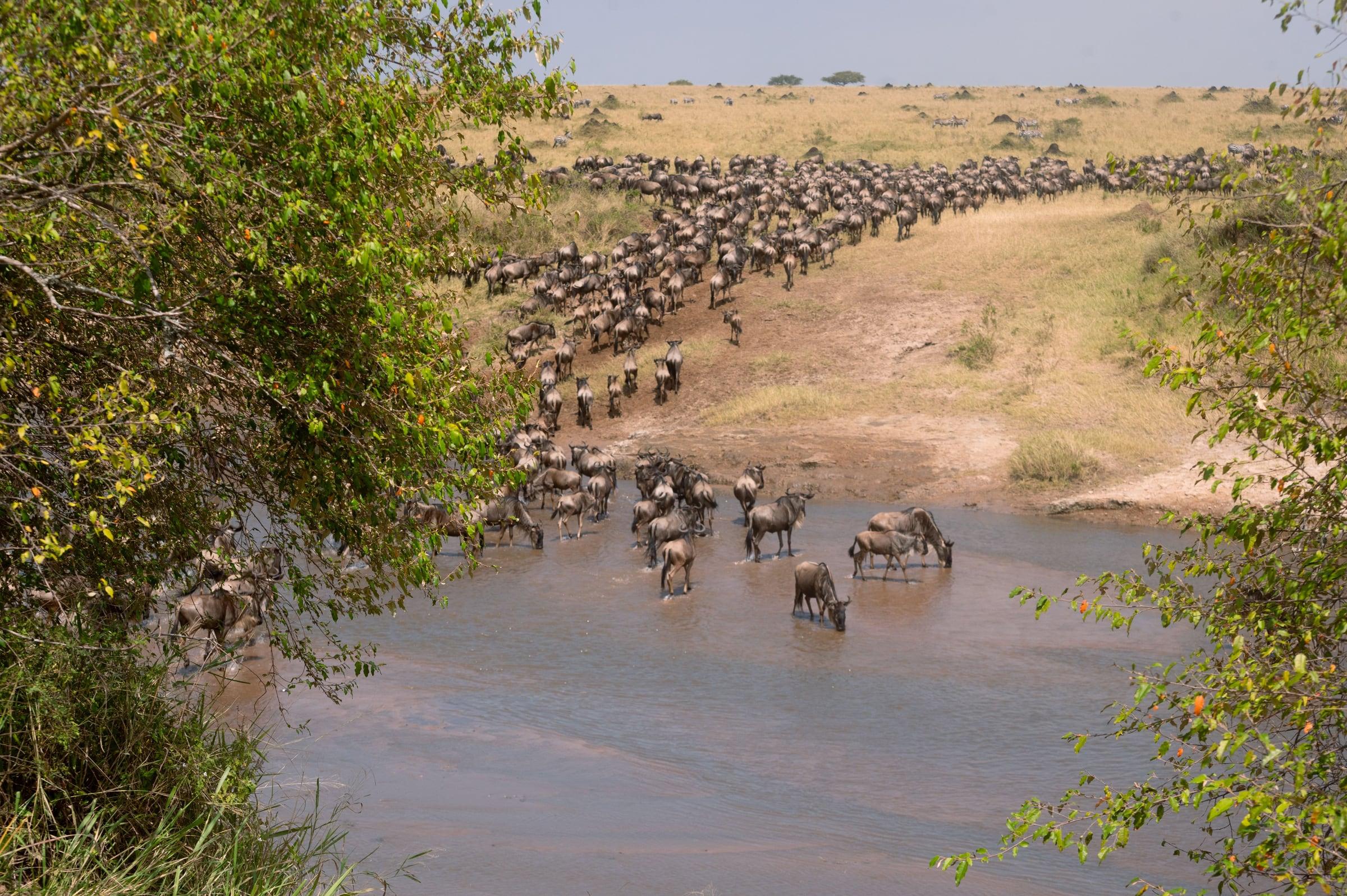
Where the herds are in each month
The pattern is the same every year, but the timing follows the rain and can move by four to six weeks from one year to the next. Each month links to our full guide for that month, with weather, prices and the other parks.
| Month | Where the herds usually are | What is happening | Where to stay |
|---|---|---|---|
| January | Ndutu and the southern Serengeti plains | The herds spread out across the short-grass plains around Ndutu, Lake Masek and Hidden Valley. Calving builds through the month. There are no river crossings at this time of year. | Ndutu |
| February | Ndutu and the southern Serengeti plains | Peak calving. Most calves are born within a few weeks, usually from late January to late February, and lion, cheetah and hyena hunt on the plains throughout. | Ndutu |
| March | Ndutu, then moving north-west | Calving tapers off. From around the middle of the month the columns start drifting toward Moru Kopjes, and the long rains usually begin late in the month. | Ndutu early in the month, central Serengeti later |
| April | Central Serengeti, between Moru Kopjes and Seronera | The long rains. Columns move north through the central plains while the southern plains empty. This is the quietest and least expensive month, and several seasonal camps close. | Central Serengeti (Seronera) |
| May | Central Serengeti into the Western Corridor | The herds move west toward the Grumeti River in long columns, and the rut is under way. The rains usually ease toward the end of the month. | Central Serengeti or the Western Corridor |
| June | Western Corridor, along the Grumeti River | The herds gather on the Grumeti River and the first river crossings of the year take place, usually in the middle to second half of the month. The dry season begins. | Western Corridor |
| July | Western Corridor to the northern Serengeti | The herds push north to the Mara River near Kogatende. The start of the crossings varies from year to year, with the first crossings in early July in some years and from mid-July in others. | Western Corridor early in the month, Kogatende later |
| August | Northern Serengeti, on the Mara River | Mara River crossings around Kogatende and the Lamai Wedge, with part of the herd moving into Kenya's Masai Mara and back. This is the busiest month in the north. | Kogatende, for three nights or more |
| September | Northern Serengeti, on the Mara River | Crossings continue much as in August, and the weather is at its driest. Together with August, this is the most reliable month for a crossing. | Kogatende, for three nights or more |
| October | Northern Serengeti, then moving south | Crossings continue in the first part of the month. As the short rains approach, the herds begin moving south through Lobo and the eastern Serengeti. | Kogatende until about 20 October, central Serengeti after |
| November | Eastern and central Serengeti, moving south | The short rains draw the herds back toward the southern plains. The first columns usually reach Ndutu late in the month, but in a year with late rains they stay in the north for longer. | Central Serengeti |
| December | Ndutu and the southern Serengeti plains | The herds settle on the short-grass plains ahead of the calving season, and the first calves can appear in the second half of the month. | Ndutu |
How the migration works
The Great Migration is the year-round movement of wildebeest, together with large numbers of zebra and Thomson's gazelle, through the Serengeti ecosystem in Tanzania and Kenya's Masai Mara. The herds follow the rain and the fresh grass it brings, so they move in roughly the same loop each year. Early in the year they are on the short-grass plains around Ndutu in the south, where the calves are born. As the plains dry out after the long rains, they move north-west through the central Serengeti to the Western Corridor, and then north to the Mara River for the dry season. When the short rains arrive in November, they return south.
Because the movement follows the weather, the dates in the table are a guide to what usually happens. In a dry year the herds can reach the north several weeks early, and late rains can keep them there into November. If your dates are fixed, we recommend choosing a month when the herds are usually settled in one area, such as February at Ndutu or August and September at Kogatende, rather than a month when they are in transit, such as early July or late October.
Ndutu, where most of the calving takes place, lies inside the Ngorongoro Conservation Area on the border of the Serengeti, so a calving safari pays Ngorongoro Conservation Area fees for the nights you spend there. Current fees are listed on our Tanzania park fees page.
The calving season and the river crossings
Most migration trips are planned around one of three events. The table below shows when and where each one takes place and which of our trips is built around it.
| Event | When | Where | Our trip |
|---|---|---|---|
| Calving season | Late January to February, with herds on the plains from December to March | Ndutu and the southern Serengeti | Calving Season Safari, from $2,640 per person |
| Grumeti River crossings | June | Western Corridor | Custom route, priced on request. See our June guide |
| Mara River crossings | July to October, most reliable in August and September | Kogatende and the Lamai Wedge, northern Serengeti | Great Migration Safari, from $4,680 per person |
For more detail on the calving, see our Ndutu calving season guide.
Where to stay, and for how long
The most important decision on a migration safari is where you sleep. In the dry season the crossing points on the Mara River are around four to five hours by road from camps in the central Serengeti, by our best estimate, so a day trip from Seronera spends most of the day in the vehicle and often arrives after a crossing has finished. For the Mara crossings we recommend at least three nights at a camp near Kogatende, which is how our Great Migration Safari is planned. The same applies to the calving season, when staying at Ndutu puts you on the plains with the herds from the first game drive of the day.
Before you book, please note the following:
- No one can promise a river crossing on a particular day. Several nights close to the river give you the best chance.
- The northern Serengeti is busy in August, and the main crossing points can draw many vehicles when a crossing starts.
- A migration safari costs more than the standard northern circuit, because the far north adds driving days, a remote-vehicle surcharge and northern Serengeti concession fees.
- The camps closest to the herds in February and from July to September often book up six to nine months ahead.
How many wildebeest are there?
The figure most often quoted is 1.5 million wildebeest, and some sources say two million. The 1.5 million figure usually includes zebra and gazelle. The most recent official count, an aerial survey by TAWIRI in 2023, estimated just under 1.4 million wildebeest. A 2025 study that counted wildebeest on satellite images using AI found far fewer. Its authors present satellite counts as a complement to aerial surveys, and the difference between the two results is still being studied.
| Count | Year | Method | Wildebeest |
|---|---|---|---|
| Tanzania Wildlife Research Institute (TAWIRI), wet-season census | 2023 | Aerial photographic survey | 1,366,109 (± 231,741) |
| Duporge et al., PNAS Nexus (University of Oxford and partners) | Published 2025, images from August 2023 | Satellite images counted by AI | 502,917 to 533,137 |
Great Migration Safari prices
Our 10-day Great Migration Safari includes three nights at Kogatende for the Mara crossings, followed by the central Serengeti and the Ngorongoro Crater. Prices include park fees, the private vehicle and guide, accommodation and meals. The calving season trip starts from $2,640 per person.
Migration season (July–October)
| Tier | 2 guestsper person | 4 guestsper person | 6 guestsper person |
|---|---|---|---|
Comfort Comfortable tented camps, including a mobile camp at the Mara River, on full board and fully private. Mawe Gnu Migration Camp (Kogatende), Tortilis Serengeti | $6,020 | $5,015 | $4,680 |
Premium Upgraded tented camp at Kogatende, positioned for the river crossings. Ang'ata Migration Camp (Kogatende), Gran Meliá Arusha | $6,895 | $5,890 | $5,555 |
Luxury Premium migration camps minutes from the crossing points, the top of our range. Lemala / Elewana migration camps, Arusha Coffee Lodge | $10,065 | $9,020 | $8,670 |
Comfortable tented camps, including a mobile camp at the Mara River, on full board and fully private.
Mawe Gnu Migration Camp (Kogatende), Tortilis Serengeti
- 2 guests (pp)
- $6,020
- 4 guests (pp)
- $5,015
- 6 guests (pp)
- $4,680
Upgraded tented camp at Kogatende, positioned for the river crossings.
Ang'ata Migration Camp (Kogatende), Gran Meliá Arusha
- 2 guests (pp)
- $6,895
- 4 guests (pp)
- $5,890
- 6 guests (pp)
- $5,555
Premium migration camps minutes from the crossing points, the top of our range.
Lemala / Elewana migration camps, Arusha Coffee Lodge
- 2 guests (pp)
- $10,065
- 4 guests (pp)
- $9,020
- 6 guests (pp)
- $8,670
Prices are per person sharing, in US dollars. The Mara River crossings run from July to October, so there is no green-season rate for this trip. The 'from' price is the Comfort tier with six guests sharing the vehicle, and the price per person falls as your group grows because the cost of the private vehicle and guide is shared between more people. Figures are built from real lodge rates, the cost of our own vehicle and current park fees. The three nights at Kogatende in the far north carry a remote-vehicle surcharge and northern Serengeti concession fees, which is why a migration safari costs more than the standard circuit.
Per person sharing a double room, for travel in 2027. Single rooms, children, and Christmas, New Year and Easter dates are quoted separately. Prices depend on availability at the named camps.
Frequently asked questions
Where is the Great Migration right now?
It depends on the month. From December to March the herds are on the short-grass plains around Ndutu in the south, where the calves are born. From April to June they move north-west through the central Serengeti to the Grumeti River in the Western Corridor. From July to October they are in the northern Serengeti on the Mara River, and in November they return south. The table at the top of this page shows each month in detail.
When are the Mara River crossings?
The Mara River crossings usually run from July to October near Kogatende in the northern Serengeti. The start varies from year to year, with the first crossings in early July in some years and from mid-July in others. August and September are the most reliable months, and the crossings become less frequent in October as the herds turn south. A booking after about 20 October carries a real risk of missing them.
Can a river crossing be guaranteed?
No. The herds can gather on the riverbank for hours and turn back, and there can be several crossings in one morning or none for a few days. What improves your chances is staying close to the crossing points for several nights. For this reason our Great Migration Safari includes three nights at Kogatende, which we regard as the minimum.
Is the Great Migration in Tanzania or Kenya?
Both, but for most of the year it is in Tanzania. The herds spend roughly December to July in the Serengeti and the Ngorongoro Conservation Area. Between about August and October part of the herd crosses into Kenya's Masai Mara and back, while the rest stays in the northern Serengeti.
Which is better, the calving season or the river crossings?
They are two different trips. The river crossings, from July to October, are the better-known spectacle. The calving season at Ndutu, from late January to February, is more predictable in its timing, generally less expensive, and has some of the year's best predator sightings because lion, cheetah and hyena follow the newborn calves. Our calving trip starts from $2,640 per person and our migration trip from $4,680 per person.
How many wildebeest are in the Great Migration?
The figure usually quoted is 1.5 million, which includes zebra and gazelle. The most recent official aerial census, by TAWIRI in 2023, estimated 1,366,109 wildebeest. A 2025 study that counted wildebeest on satellite images from August 2023 found around 500,000 to 530,000. The two methods give very different results, and the difference is still being studied.
Is April or May a good time to see the migration?
It can be, if you are flexible. The long rains make some tracks muddy and several seasonal camps close, but the herds are in the central and western Serengeti in long columns, lodge rates are at their lowest, and there are very few other vehicles. April suits travellers who want value and quiet more than a specific event.
Should we drive or fly to the northern Serengeti?
Both work. The drive from the central Serengeti to Kogatende takes around four to five hours on the road, by our best estimate, and longer as a game drive. Flying saves that day, and many guests fly back to Arusha or on to Zanzibar from the northern airstrips instead of spending two days driving south. Our page on driving or flying between parks compares the two.
Plan a safari around the herds
Tell us the month you can travel, and we will plan the route around where the herds usually are at that time and send you a day-by-day itinerary with a full price within 24 hours.