Serengeti National Park
The migration spends around nine months of the year in the Serengeti, and about 3,000 lions live in the wider Serengeti ecosystem all year.
Plan a Safari HereSee it on the Northern Circuit map
About Serengeti National Park
The open, short-grass plains south of Naabi Hill have no trees for a geological reason. They lie on a hard calcrete layer formed from ash erupted by Ol Doinyo Lengai, Africa's only active carbonatite volcano, and by the long-extinct Kerimasi, and this hardened ash prevents trees from taking root. The ash is also rich in sodium, calcium and phosphorus, which the 1.3 million wildebeest cows need for milk during the calving season, so the herds gather here in January and February. The migration therefore follows the soil chemistry of these plains as well as the rain, and that chemistry has not changed in 150,000 years.
The park covers 14,763 square kilometres and is usually divided into five zones, each with its own wildlife patterns and visitor numbers. The central Seronera Valley, built around a permanent river and its gallery forest, is the most reliable area all year. The southern plains around Ndutu are the calving grounds in February, the western corridor along the Grumeti River is where the June crossings take place, and the northern Serengeti around Kogatende is where the Mara River crossings happen in August and September. Lobo in the northeast is the least visited zone and one of the most underrated, with permanent springs, elephants throughout the year, and the migration passing through on its way south in October and November.
Some 3,000 lions live in the wider Serengeti-Mara ecosystem, although this figure comes from a model rather than a full count. The Serengeti Lion Project, which George Schaller founded in 1966 and which has run without a break since then, monitors around 330 lions in 24 prides in its central study area. Craig Packer led the project from 1978 until 2014, when Tanzania banned him after he published research that exposed corruption in the trophy hunting industry. More than 5,000 lions have been named, their family trees mapped and their health followed across 12 generations, and no other large-mammal population has been studied as closely or for as long.
Most safari websites describe the Serengeti as Big Five country, but the black rhino needs an explanation. Around 700 black rhinos lived in the Serengeti in the early 1970s, and poaching had reduced them to three animals by 1993. A reintroduction at Moru Kopjes in 2010, followed in 2019 by the translocation of nine more into the neighbouring Ikorongo-Grumeti concession, has rebuilt the population to roughly 50 to 70 animals. Seeing one requires a ranger-led excursion to Moru Kopjes with a special permit, so rhinos are not part of a normal game drive. For reliable rhino sightings, we recommend the Ngorongoro Crater.
The number of wildebeest is disputed. The aerial census by TAWIRI and the Frankfurt Zoological Society puts the migratory herd at approximately 1.3 million. A 2025 study by Oxford University, using AI-assisted analysis of satellite images, produced estimates of 325,000 to 533,000 and attributed the difference to the methods used rather than to a fall in numbers. The figure of 1.5 to 2 million found on many operator websites includes zebra and gazelle as well as wildebeest. The true figure probably lies somewhere between 500,000 and 1.5 million, and we use 1.3 million, the census figure, on this page.
Wildlife in Serengeti
Lion
The Serengeti Lion Project (1966 to the present) monitors around 330 lions in 24 prides in its central study area and has followed more than 5,000 individuals across 12 generations. Lions are most numerous around the Seronera Valley, Simba Kopjes and Maasai Kopjes, and along the Grumeti River.
Leopard
The sausage trees (Kigelia africana) along the Seronera River are among the best leopard habitats in Africa, and several generations of leopards used to vehicles have been monitored here since the 1960s. Leopards are also seen reliably around Maasai Kopjes and in the riverine woodland of the western corridor.
Cheetah
The Serengeti Cheetah Project estimates 250-500 cheetahs in the ecosystem. They are seen most reliably on the southern plains and around Ndutu in the wet season, when the Thomson's gazelle gather there. The Namiri Plains in the east, which reopened after years as a cheetah research area, regularly produce sightings of coalitions.
Elephant
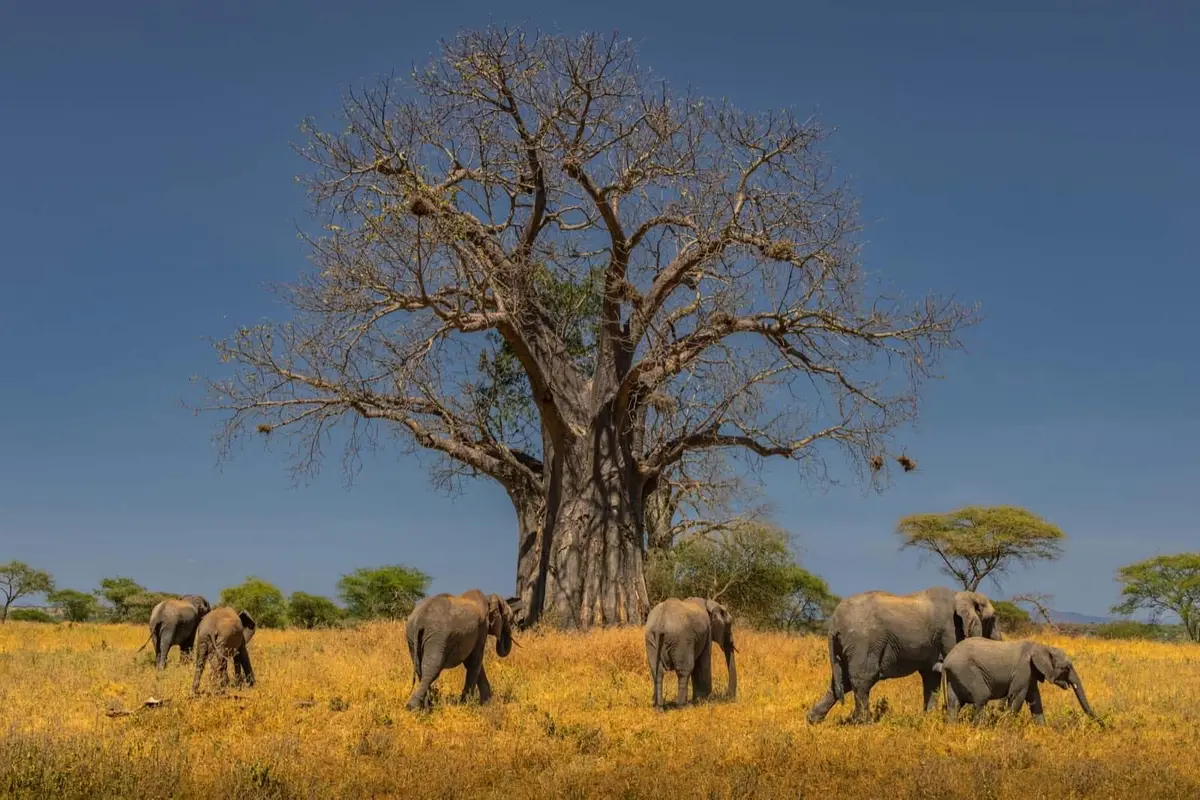
The 2014 TAWIRI/TANAPA census counted approximately 6,011 elephants in the Tanzanian part of the ecosystem, an increase of 98% since 2009. They are most numerous in the northern Serengeti around Lobo and in the western corridor. Serengeti elephants move in smaller family groups across a much larger area than the large dry-season herds of Tarangire.
Wildebeest
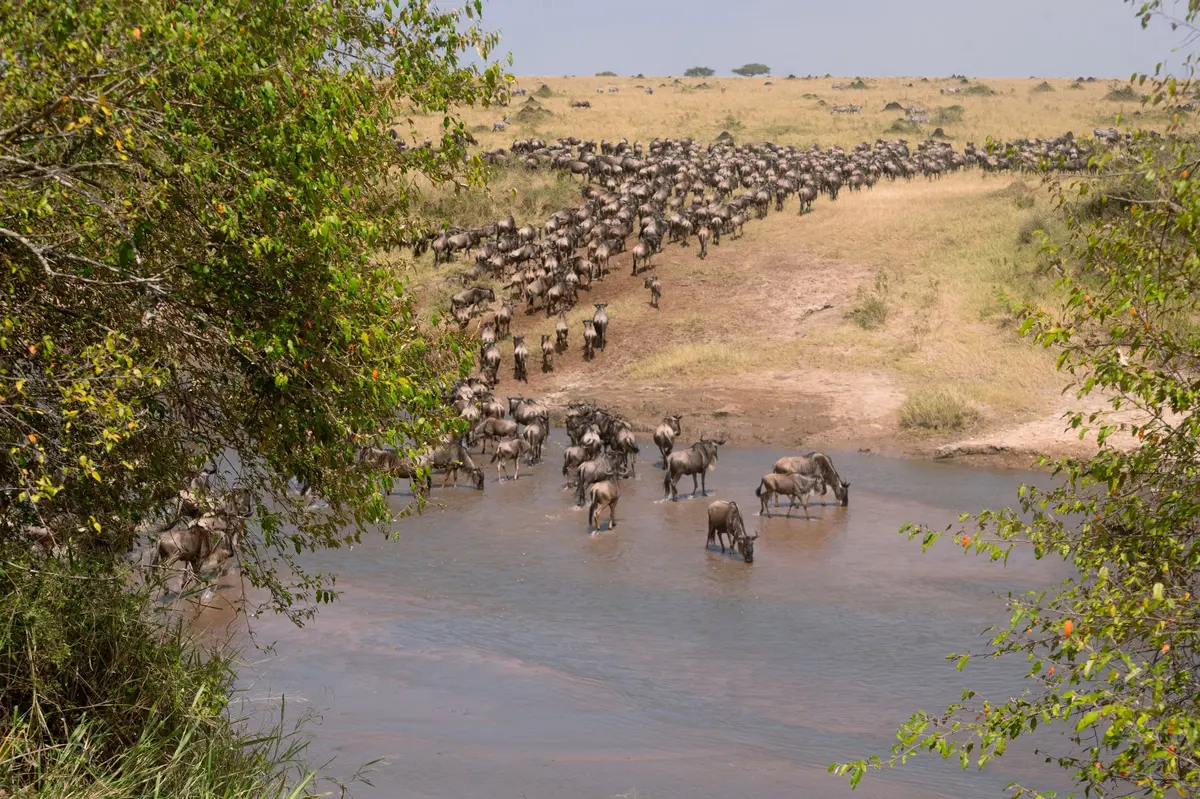
The TAWIRI/FZS aerial census counts approximately 1.3 million migratory wildebeest. The calving peak runs from late January to early March, with thousands of calves born a day at its height, and the Mara River crossings in the northern Serengeti between July and October are the most dramatic single wildlife event in Africa.
Buffalo
The park holds 30,000-40,000 buffalo. In the dry season herds of 500-1,000 gather around permanent water, among the largest in East Africa, and they are seen most reliably around Seronera all year and in the western corridor in July and August.
Specialist Birds
More than 500 species have been recorded in the ecosystem. Three species with small ranges are worth looking for, namely the grey-crested helmet-shrike, which is endemic to the Serengeti-Mara ecosystem and reliable in the Seronera acacia woodland, Fischer's lovebird, which is found in northern Tanzania and is reliable in the western corridor, and the rufous-tailed weaver, a Tanzanian endemic that is common around Seronera.
The Great Migration
The Great Migration is a continuous movement of approximately 1.3 million wildebeest, 200,000 zebra and hundreds of thousands of gazelle between Tanzania and Kenya, driven by the rains. The herds spend around nine months of the year in Tanzania. The calendar below shows the usual pattern, but the timing changes from year to year with the rains.
Jan-Feb (South, Ndutu area)
Calving season on the volcanic short-grass plains. The peak runs from late January to early March, and February is the safest single month to book. Thousands of calves are born a day at the peak, and predator activity is intense. Please note that Ndutu lies in the Ngorongoro Conservation Area rather than Serengeti National Park.
Mar-May (Central to West)
The herds move northwest through the central Serengeti as the rains move on, and the landscape is green and quiet. Late April and May bring heavy rain that can make some tracks impassable.
Late May-Jul (Western Corridor, Grumeti)
The Grumeti River crossings, the first major river the herds must cross, peak in June. There are fewer vehicles than at the Mara, as Asilia's field data puts the average at fewer than 15 vehicles per crossing, and the Singita Grumeti concession limits visitor numbers.
Aug-Oct (Northern Serengeti, Mara)
The Mara River crossings take place at Kogatende and in the Lamai Wedge, with the peak in August and early September. Field logs recorded active crossings as late as 21 October 2024, and there are far fewer vehicles at the Kogatende crossings than on the Kenyan side. The first herds arrive in early July in some years and from mid-July in others.
Nov-Dec (South, returning)
The herds return south through Lobo and the central Serengeti after the short rains. For travel in October and November, we recommend Lobo, where you can see the migration heading south without the crowds of August.
For the river crossings from July to October, see our guides to the Mara River crossing and the northern Serengeti (Kogatende and Lamai). For the other parts of the park, see the central Serengeti and Seronera and the Western Corridor and the Grumeti River.
The Five Zones: Where to Go and When
The southern plains around Ndutu are the calving grounds, with the peak from late January to early March. These plains lie in the Ngorongoro Conservation Area rather than Serengeti National Park, so Ngorongoro Conservation Area fees apply there. Ndutu is 100-110 km from Seronera, roughly 2 to 2.5 hours by road. The permanent camps include Ndutu Safari Lodge and Lake Masek Tented Camp, while mobile camps such as Lemala, Asilia Olakira, Nomad and Sanctuary Kusini operate from December to March and then move north with the herds. For February we recommend booking six to nine months ahead.
The Seronera Valley is the most reliable area all year. The permanent Seronera River attracts grazing animals and therefore predators, so lion, leopard, buffalo and hippo can be seen here in any month. The sausage trees (Kigelia africana) in the gallery forest are among the most reliable leopard habitats in Africa, and several generations of Seronera leopards have been monitored since the 1960s. The Retima Hippo Pool, at the meeting of the Seronera and Orangi rivers 8 km north of Seronera Airstrip, holds around 200 hippos and is one of the few places in the park where you can leave the vehicle. Moru Kopjes in the southwest, a 30 to 45-minute drive from Seronera, is the only area with black rhino and can only be visited on a ranger-led excursion with a permit. The kopjes also have Maasai rock art from the 18th and 19th centuries, painted in ochre, charcoal and white clay, which some sources wrongly describe as San or Bushman art.
The western corridor, along the Grumeti River, is where the June crossings take place. The Grumeti is the first serious river the herds must cross, and its slow, deep pools hold very large Nile crocodiles. There are fewer vehicles than at the Mara, as Asilia puts the average at fewer than 15 vehicles per crossing. Much of the corridor lies within the Singita Grumeti Reserves, a private concession of 350,000 acres next to the national park, and the black-and-white colobus monkeys in its riverine forest are rarely seen elsewhere in the ecosystem.
The northern Serengeti, around Kogatende and the Lamai Wedge, is where the Mara crossings take place. The first large herds arrive in early or mid-July, depending on the year, and the peak is in August and early September, with crossings recorded as late as 21 October 2024. TANAPA numbers the crossing points, and the most active in recent seasons have been Points 0, 1, 4, 7 and 10. The Lamai Wedge, north of the river and reached by a seasonal bridge, has fewer camps and fewer vehicles than Kogatende. The drive from Seronera is 160 km and takes four to five hours, while a charter flight takes 45 to 50 minutes.
Lobo, in the northeast, is not part of most standard itineraries, which is one of its advantages. Permanent springs at Gaboti, Bololgeni and Lobo Springs support wildlife all year, including one of the park's largest lion prides, and there are more elephants, more consistently, than in the central Serengeti. The migration passes through on its way south in October and November. Lobo Wildlife Lodge, built into a granite outcrop in 1968, is an unusual building, although its facilities are dated.
Planning Around the Migration
Two misunderstandings about the Great Migration appear on many safari websites.
The first is that the migration follows a fixed calendar, with the Grumeti crossings in June and the Mara crossings in August. In reality the calendar shows the usual pattern, and the timing changes with the rainfall each year. In 2023 the herds began arriving in large numbers on the Kenyan side of the Mara in mid-July, while in 2024 crossings were recorded at Mara Point 7 on 21 October. For this reason we recommend staying four to five nights in a crossing area, as one night is rarely enough.
The second is that the migration is a single herd that you can meet at one point. At its widest the migration is spread across more than 30,000 square kilometres, and a crossing can be taking place at Kogatende while another group is still moving through the central Serengeti. Your guide's radio contact with other guides across the park is therefore more useful than staying close to one named crossing point.
At the river, the herds often gather, approach the bank several times over a number of hours and then turn back without crossing. Some visitors see an hour of chaos and others wait for four days, so crossings cannot be guaranteed, which is another reason to stay longer.
The most reliable approach is to combine zones, for example Ndutu for the calving in February, or a charter flight north to Kogatende for the crossings in August and September. Operators such as Asilia, Nomad, &Beyond and Singita plan trips around 45-minute charter flights between groups of camps, because a stay in a single zone gives you only one chance at the right timing.
The Serengeti Lion Project
The Serengeti Lion Project has run without a break since 1966, which makes it the longest continuous study of a large mammal anywhere in the world. George Schaller began it, Brian Bertram continued it, and Craig Packer took over in 1978 and led it until 2014, when Tanzania banned him from the country after he published research that exposed corruption in the trophy hunting industry. Tanzanian and international researchers have continued the project since then.
More than 5,000 individual lions have been named, their family trees mapped and their health followed across 12 generations, and every lion in the central study area has a known history, including its birth date, pride, injuries and offspring. The project's research on how male lions form coalitions, on infanticide as a mating strategy and on the evolution of the mane is now standard reading in behavioural ecology.
This research also benefits visitors directly. The radio network that guides use to find out which prides are active around which kopjes was built partly through relationships formed with the Lion Project.
Getting Here and Around
The drive from Arusha to Seronera via Karatu and Naabi Hill Gate is 325-340 km, on tarmac as far as Karatu, then graded gravel through the Ngorongoro Conservation Area and unpaved roads inside the park. It takes about 7 to 8.5 hours without stops, so most visitors fly. A charter flight from Arusha to Seronera Airstrip takes 1 to 1.5 hours with Coastal Aviation, Auric Air, Regional Air, Flightlink or Air Excel, while scheduled bush flights take longer but cost less.
Eight public airstrips serve the different zones, namely Seronera (central, with a 2,280 m runway), Kogatende (north, for the Mara crossings), Lamai (far north), Lobo (northeast), Kirawira (western corridor), Kusini (south), Fort Ikoma (just outside the western boundary), and the seasonal Ndutu airstrip, which operates from December to March and lies within the NCA. Singita Grumeti has its own private airstrip that can take jets, and charter flights between zones take 45 to 50 minutes.
Off-road driving is prohibited inside Serengeti National Park, and vehicles must stay on the designated tracks. Self-drive is permitted, but we rarely recommend it, because the distances are large, the tracks are unmarked and you will not have access to the radio network that guides use to find lion and cheetah. Almost every visitor travels with a private guide.
Entry Fees (2026)
| Fee Item | Amount | Notes |
|---|---|---|
| Non-resident adult entry (peak, 16 May - 14 Mar) | $82.60 (VAT incl.) | Including 18% VAT |
| Non-resident adult entry (low, 15 Mar - 15 May) | $70.80 (VAT incl.) | Including 18% VAT |
| Child age 5-15 | $23.60 (VAT incl.) | Both seasons, per person |
| Under 5 | Free | |
| Concession fee (lodges inside park) | $70.80 per person/night | Often included in the lodge rate |
| Balloon safari (Serengeti Balloon Safaris Ltd) | $659 per person | Includes the $40 TANAPA permit, a flight of approximately 60 minutes, champagne and a bush breakfast. Park entry is not included. |
| Vehicle fee (TZ-registered Land Cruiser, ~3,000 kg) | ~TZS 41,300 (~$17-20) | Paid at the gate in Tanzanian shillings |
| VAT | 18% | Applied to all fees at the GePG payment gateway |
| Payment method | Card only | No cash at any TANAPA gate. Fees from the 2023/24 TANAPA tariff; re-verify after July 1, 2026. |
How these fees are counted on a real trip: Tanzania park fees 2026. All fees are included in Saleh Safaris package prices.
Best Time to Visit Serengeti
| Months | Weather | Wildlife | Crowds |
|---|---|---|---|
| Jan-Feb | Warm, with short daily showers on the southern plains | Calving season, with thousands of calves a day at the peak and the most predator activity of the year. | Moderate, and an underrated time to visit |
| Mar-May | The long rains, when tracks in the centre and west can flood. | The herds are spread out and moving northwest, and the tall grass makes animals harder to see. | Low |
| Jun-Jul | Dry, with cool mornings of approximately 12°C at Seronera and warm afternoons | The Grumeti crossings take place in the west in June, and the resident wildlife at Seronera is excellent all year. | High |
| Aug-Oct | Dry and warm, and dusty in the north. | The Mara River crossings in the northern Serengeti are at their peak, and this is the best time overall for game viewing. | Peak (Aug-Sep) |
| Nov-Dec | The short rains, with a green landscape and dramatic skies. | The herds return south through Lobo and the central Serengeti. | Moderate |
Where to Stay
Our guides to lodges and camps for Serengeti National Park. Every lodge we work with is in the lodge directory.
- Conserve Safari Central SerengetiIkoma side, 6 km from Ikoma Gate
- Siringit Serengeti Camp6 km east of Seronera airstrip
- Jackals LairNyabogati area, about 1 hour from Seronera airstrip
- Serengeti Serena Safari LodgeAcacia ridge, central Serengeti
- Serengeti Sametu CampNgare Nanyuki River, central-eastern Serengeti
- Gnus LairKogatende area, about 10 minutes from the Mara River
- Serian's Serengeti LamaiLamai Wedge, about 1 km from Crossing Point 4 on the Mara River
- Serengeti Mara River CampKogatende, about 10 minutes from the Mara River
Frequently Asked Questions
What is the Serengeti famous for?
The Serengeti is famous for the Great Migration and its lions. The migration is a continuous loop of approximately 1.3 million wildebeest between Tanzania's Serengeti and Kenya's Maasai Mara, driven by the rains and by the volcanic soils of the southern plains. The Serengeti also has one of the highest lion densities in the world, and the Serengeti Lion Project has monitored more than 5,000 individual lions since 1966. Leopard viewing in the sausage trees along the Seronera River is among the most reliable in Africa.
How many days do you need in the Serengeti?
We recommend at least three full days, and four to five if possible. For the Mara River crossings between July and October, we recommend at least four nights in the northern Serengeti, and for the calving peak from late January to early March, at least three nights in the Ndutu area, ideally four to five. For a full northern circuit that also includes Ngorongoro and Lake Manyara, allow six to eight days in total.
What is the best month to visit the Serengeti?
It depends on what you would like to see. February is the safest single month for the calving on the southern plains, while August and early September are the peak months for the Mara River crossings in the north. June brings the Grumeti crossings in the west, with far fewer vehicles than at the Mara. June to October is the dry season, with short grass, wildlife gathered around water and the lowest malaria risk. If road conditions and access are important to you, we recommend avoiding mid-March to mid-May.
Is the Serengeti better than the Maasai Mara?
For seeing the migration at any time of year, the Serengeti is the better choice, as the herds spend around nine months of the year in Tanzania. The Mara is easier to reach from Nairobi, while the Serengeti is about ten times larger and has a wider variety of habitats. On cost, Tanzania's peak entry fee of $82.60 per day is now lower than the Mara's peak-season fee of $200 per day, so the old assumption that Kenya is cheaper no longer holds. Both sides offer the same Mara River crossings, and Tanzania's Kogatende has fewer vehicles at each crossing.
How much does a Serengeti safari cost?
In 2026, typical all-inclusive ranges per person are $250-400 per day for a budget safari, $400-700 per day for a mid-range private safari, and $700-1,500 or more per day at luxury camps and lodges. A five-day mid-range private Serengeti safari usually costs $2,200-3,000 per person in total, including park fees, transfers, accommodation, meals, the guide and the vehicle. A balloon flight with Serengeti Balloon Safaris Ltd costs $659 per person and is not included in most standard packages.
When does the Great Migration happen in the Serengeti?
The migration is in the Serengeti for around nine months of the year. The calving peak on the southern plains runs from late January to early March, the Grumeti River crossings in the western corridor peak in June, and the Mara River crossings in the northern Serengeti peak from August to early September, with crossings possible until October. The herds return south through Lobo and the central Serengeti in November and December.
What is the cheapest time to visit the Serengeti?
April to mid-May is the least expensive time. TANAPA's low-season entry fee of $70.80 per day applies, compared with $82.60 in the peak season, and most lodges offer discounts of 30-50%. However, the tall grass makes animals harder to see, some tracks become impassable after heavy rain, and the migrating herds are spread across the central Serengeti rather than gathered at a crossing. If value is more important to you than the river crossings, this is a good time to consider.
Can you self-drive in the Serengeti?
It is permitted, although we rarely recommend it. You need a high-clearance 4x4, which can be hired in Arusha for $150-250 per day, park permits, GPS and experience of driving on unpaved tracks over long distances. Off-road driving is prohibited, and vehicles must stay on the designated tracks. The main disadvantage is that you will not have access to the radio network that guides use to find lion, leopard and cheetah, and visitors used to driving themselves in Kruger or Etosha often underestimate how many sightings this costs them.
Is the Serengeti safe?
Yes, the park is safe. The usual wildlife precautions apply, so you should only leave the vehicle at authorised stopping points such as the Retima Hippo Pool, Naabi Hill and the walking area at Moru Kopjes, keep your tent zipped closed and never approach animals on foot. Crime against tourists inside the park is minimal, and the usual precautions apply in Arusha and on the way to the park.
Is malaria a risk in the Serengeti?
Yes, the Serengeti is a malaria area. The CDC recommends prophylaxis for all visitors, and common options include atovaquone-proguanil (Malarone), doxycycline and mefloquine. Mosquitoes are least active in the dry season from June to October, and long sleeves and DEET repellent at dawn and dusk reduce the risk considerably. We recommend visiting a travel clinic four to six weeks before you leave.
What animals will I see in the Serengeti?
On a three-day visit to Seronera you can expect to see lion, which is very likely, leopard, which is reasonably likely, especially in the sausage trees along the Seronera River, and cheetah, which is likely on the southern plains and around Namiri. You will also see elephant, buffalo, hippo, giraffe, zebra, wildebeest, Thomson's and Grant's gazelle, topi, hartebeest, impala, warthog, jackal and hyena. Black rhino can only be seen on a ranger-led excursion to Moru Kopjes with a permit and are not part of a normal game drive. More than 500 bird species have been recorded in the park.
Can you see the Big Five in the Serengeti?
All five species live in the Serengeti, but rhinos are difficult to see. Lion, leopard, elephant and buffalo are seen regularly over three to four days, while the 50 to 70 black rhinos live around Moru Kopjes and can only be seen on a ranger-led excursion with a permit. For a reliable chance of the Big Five, including rhino, we recommend combining the Serengeti with the Ngorongoro Crater, which holds more than 50 rhinos in a much smaller, enclosed area where they are easier to see.
Safari Itineraries Including Serengeti