Tanzania Safari in March
Most camps lower their rates on March 1, while the calving herds are still on the southern plains and the long rains usually hold off until the middle of the month. This makes the first twenty days or so of March one of the best-value periods of the year, as the wildlife viewing is still similar to February while prices have already moved to the green season. The last week of the month is usually wetter, with muddy tracks, camp closures and herds on the move, so we recommend travelling in the first half of March.
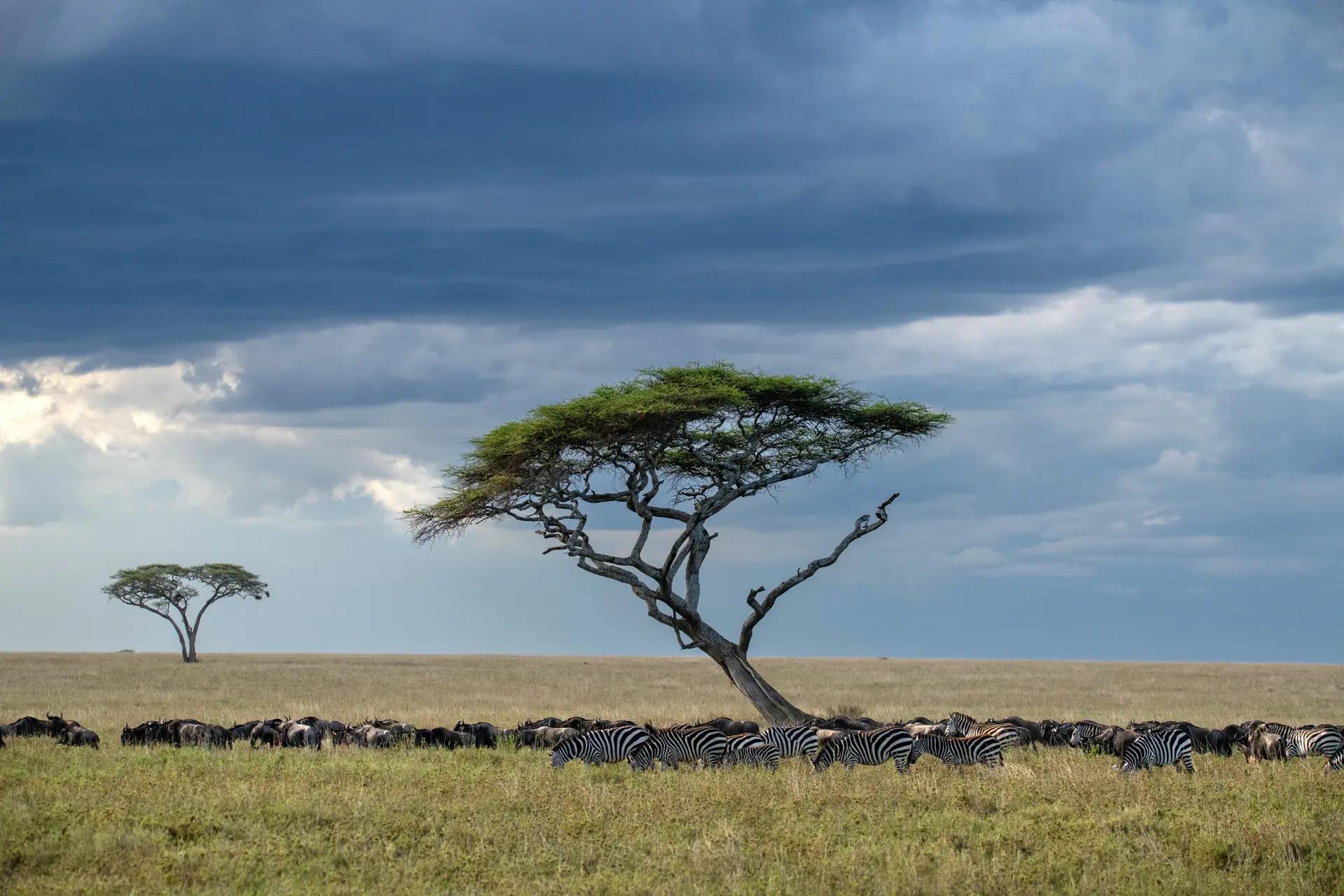
Wildlife Conditions in March by Park
Southern Serengeti / Ndutu (early) then Central (late)
GoodIn early March there is still a lot of predator activity from the calving season, with far fewer vehicles than in February. From mid-month the herds move northwest towards Moru Kopjes and the edge of Seronera, and the best game viewing shifts to the central Serengeti. Late in the month the black-cotton soil on the tracks becomes heavy, and a 4x4 is essential.
Ngorongoro Crater
GoodThe crater floor holds plenty of wildlife whatever the weather, which makes it the most reliable part of a March itinerary. The grass grows longer as the rains build and the descent road can be slippery, although game numbers stay high, and there are fewer vehicles as the month goes on.
Ndutu (NCA)
GoodGame viewing is good in early March as the calving comes to an end. In the last ten days of the month the black-cotton soil turns to mud, and most mobile camps close until the next season.
Lake Manyara
FairThe long rains thicken the vegetation, which makes animals harder to see, although birdwatching is excellent while the migrant birds are still here.
Tarangire National Park
FairWildlife spreads out with the rains, and the tracks become muddy late in the month, although birdwatching is good. Tarangire is at its best in the dry season, from July onwards.
March Week by Week
March 1-7
Best location: Ndutu
The last of the calving, with the herds still in the south, fewer vehicles and green-season rates from the 1st. This is usually the best-value week of the first quarter.
March 8-14
Best location: Ndutu / Kusini
Calving slows down, the herds begin moving west and north, and the first storms of the long rains may arrive.
March 15-21
Best location: Moru Kopjes / Seronera fringe
The herds move towards Moru Kopjes and the central Serengeti. Calving is largely over, and the landscape is green with dramatic skies.
March 22-31
Best location: Seronera / Moru Kopjes
The herds are clearly moving northwest, the tracks are muddy and the Ndutu mobile camps are closing as the long rains set in.
| Week | What's Happening | Best Location |
|---|---|---|
| March 1-7 | The last of the calving, with the herds still in the south, fewer vehicles and green-season rates from the 1st. This is usually the best-value week of the first quarter. | Ndutu |
| March 8-14 | Calving slows down, the herds begin moving west and north, and the first storms of the long rains may arrive. | Ndutu / Kusini |
| March 15-21 | The herds move towards Moru Kopjes and the central Serengeti. Calving is largely over, and the landscape is green with dramatic skies. | Moru Kopjes / Seronera fringe |
| March 22-31 | The herds are clearly moving northwest, the tracks are muddy and the Ndutu mobile camps are closing as the long rains set in. | Seronera / Moru Kopjes |
Tanzania Weather in March
The weather in Tanzania in March changes during the month, as the long rains usually begin somewhere in the second half. Average rainfall rises from February in every location in the table below, and in Arusha it almost doubles to about 146 mm. The temperature in Tanzania in March stays warm, with average highs of 27 to 29°C in the parks and mild nights. Monthly averages cannot show the timing within the month, but in most years the first half of March is drier than the second, which is why we recommend the first twenty days or so, as explained further down this page.
| Location | Average high | Average low | Rainfall | Rain days |
|---|---|---|---|---|
| Arusha1,350 m above sea level | 28°C83°F | 16°C60°F | 146 mm | 15 |
| Tarangire1,180 m above sea level | 29°C85°F | 17°C63°F | 130 mm | 15 |
| Central Serengeti (Seronera)1,490 m above sea level | 28°C82°F | 15°C60°F | 121 mm | 16 |
| Ndutu (southern Serengeti)1,640 m above sea level | 27°C80°F | 15°C58°F | 114 mm | 16 |
| Ngorongoro Crater rim2,280 m above sea level | 23°C73°F | 10°C50°F | 136 mm | 18 |
| Zanzibar18 m above sea level | 33°C91°F | 25°C76°F | 177 mm | 11 |
Long-term monthly averages. The mainland figures are 1961 to 1990 averages from the Climatic Research Unit climate grid, because we could not find published averages from a weather station inside the parks. The Zanzibar figures are the official 1991 to 2020 averages for the island's weather station. Rain days count days with at least 0.1 mm of rain on the mainland and at least 1 mm on Zanzibar. Sources are listed at the end of the page. The averages for every month are on our Tanzania weather by month page.
Early mornings and the middle of the day
Mornings in March are mild, with average lows of about 15°C on the Serengeti plains and 17°C in Tarangire, and the air becomes more humid as the rains approach. In most years thunderstorms build during the day, so the morning game drive is usually the most comfortable and most reliable time to be out, and we suggest keeping the afternoon plan flexible.
On the Ngorongoro Crater rim
The Ngorongoro rim averages about 10°C at dawn in March and receives more rain than the parks below, with some rain on about 18 days of the month. The crater floor, several hundred metres lower, is around 3°C warmer during the day, so the descent usually brings a noticeable change in temperature.
What to pack for March
For March we recommend a good waterproof jacket, quick-drying clothes and shoes that can cope with mud at camps and airstrips, along with a fleece for early starts and the rim. A dry bag or rain cover for cameras is useful in an open-roof vehicle when a shower arrives. On Zanzibar March is hot and humid, and rainfall rises sharply from February to about 177 mm.
How the weather affects game viewing in March
In the first half of March the herds are usually still on the short-grass plains around Ndutu, and the weather has little effect on game viewing. Once the long rains set in, the herds begin to move west and north, tracks around Ndutu become harder to drive and some seasonal camps close, which is why we recommend the first half of the month. The green landscape, storm skies and quiet parks suit photographers who are happy to accept some rain.
The Value of March 1 to 20
March is often described as a transitional month, but for lodge rates it divides clearly in two. Most camps lower their rates on March 1, by 25 to 30 percent compared with the calving season in January and February. During the first two weeks of March, however, the herds are usually still on the southern plains, the last calves are being born and the predators are still in the same areas as in February.
This combination of very good wildlife viewing and green-season prices usually lasts until around the 20th. After that the rains normally arrive in earnest, the herds move towards Moru Kopjes and the Ndutu mobile camps start to close. If you can only travel in March, we recommend the first half of the month. The second half suits photographers who would like storm light and quiet parks, and who do not mind the chance of muddy tracks.
Rainfall, Flexible Booking and Ramadan 2027
The weather in March varies a great deal from year to year. In a dry year the rains hold off and late March can be excellent, while in a wet year they may arrive around the 10th and make the second half of the month difficult. As this cannot be predicted in advance, flexible booking terms are especially useful in March. Our March quotes set out the cancellation and date-change terms for each property, and we prefer camps with all-weather access roads.
Ramadan 2027 is expected to run from about 7 February to 8 March, which covers the first week of the month. Safaris on the mainland are not affected, and for Muslim travellers early March is a good time for a Ramadan safari, with quiet parks, cool overcast afternoons that make fasting easier, and iftar in camp. During Ramadan, Stone Town on Zanzibar is quieter, while the beach resorts operate much as usual.
March Itineraries
Calving Season Safari
From $2,640 pp7 Days / 6 Nights
Ndutu · Ngorongoro
Available in early March while the herds are still in the south, with the end of the calving season at green-season lodge rates.
View Full Itinerary5-Day Northern Circuit
From $1,815 pp5 Days / 4 Nights
Tarangire · Serengeti · Ngorongoro
This shorter circuit suits March well, as it is built around the Ngorongoro Crater, which is good in any weather, and the central Serengeti as the herds arrive.
View Full ItineraryQuestions About a Tanzania Safari in March
Is March a good month for a Tanzania safari?
Early March is excellent, as the end of the calving season still brings a lot of predator activity and lodge rates drop by 25 to 30 percent on March 1. Late March is less reliable, because the long rains usually arrive in the middle or later part of the month and some camps close. If your dates are flexible, we recommend the first three weeks.
Where are the wildebeest herds in March?
In early March the herds are usually still on the southern short-grass plains around Ndutu. From around the middle of the month they begin moving northwest towards Moru Kopjes and the central Serengeti, following the new grass. As the herds are on the move, a guide who follows their position each day is especially useful in March.
Is March too wet for safari?
The first half of the month is generally fine, especially on the northern circuit. Rain usually comes as an afternoon thunderstorm that clears within an hour or two, and mornings are rarely affected. The wettest period is usually the final week, and the remote southern parks are more affected. As March varies from year to year, we recommend flexible booking terms for this month.
Which parks work best in March?
We recommend the northern circuit, with Ndutu and the southern Serengeti for the end of the calving season in early March, the Ngorongoro Crater, which is good in any weather, and the central Serengeti as the herds arrive late in the month. The remote southern parks such as Ruaha and Nyerere are best left until the rains end.
How much cheaper is March?
From March 1, lodge rates are roughly 25 to 30 percent below the calving-season rates of January and February, and around 30 to 40 percent below the peak season from July to October. Park entry fees are a little lower from March 15, although most of the saving comes from accommodation. Our 7-day Calving Season Safari starts from $2,640 per person and costs less in March than in February for the same route.
Can I still see the migration in March?
Yes. In early March you can see the end of the calving season in the south, and in the second half of the month the start of the move north, with long lines of wildebeest heading towards Moru Kopjes. As the herds are moving, a guide with current information on their position is more useful than a fixed plan.
What is the temperature in Tanzania in March?
March is warm, with average highs of about 27 to 29°C in Arusha, Tarangire and the Serengeti and about 23°C on the Ngorongoro Crater rim. Mornings are mild, at about 15 to 17°C in the parks and 10°C on the rim. Rainfall rises during the month as the long rains begin, usually in the second half.
Sources and Maintenance
Where these figures come from
The temperatures and rainfall in the weather table are long-term averages, and a single year can be wetter, drier, warmer or cooler. We could not find published long-term averages from a weather station inside the northern parks, so the park figures come from the Climatic Research Unit's global climate grid, which builds each grid cell of about 18 km from nearby station records and allows for altitude. The Zanzibar figures are the official 1991 to 2020 averages for the island's weather station. As a check, the official 1991 to 2020 averages for Kilimanjaro International Airport are about 1 to 2°C warmer by day than the grid figures for the same area, so please treat the daytime highs as slightly conservative.
- Climatic Research Unit, University of East Anglia: CRU CL v2.0 global climatology, 10-minute grid (New et al. 2002) (1961-1990 averages for the grid cells covering Arusha, Tarangire, Seronera, Ndutu, Kogatende, the Western Corridor and the Ngorongoro Crater rim and floor, read 24 November 2026)
- World Meteorological Organization 1991-2020 climate normals, Zanzibar station 63870 (published by NOAA NCEI) (average high, low, rainfall and days with 1 mm or more, read 24 November 2026)
- World Meteorological Organization 1991-2020 climate normals, Kilimanjaro International Airport station 63791 (published by NOAA NCEI) (used to cross-check the Arusha grid figures, read 24 November 2026)