Tanzania Safari in September
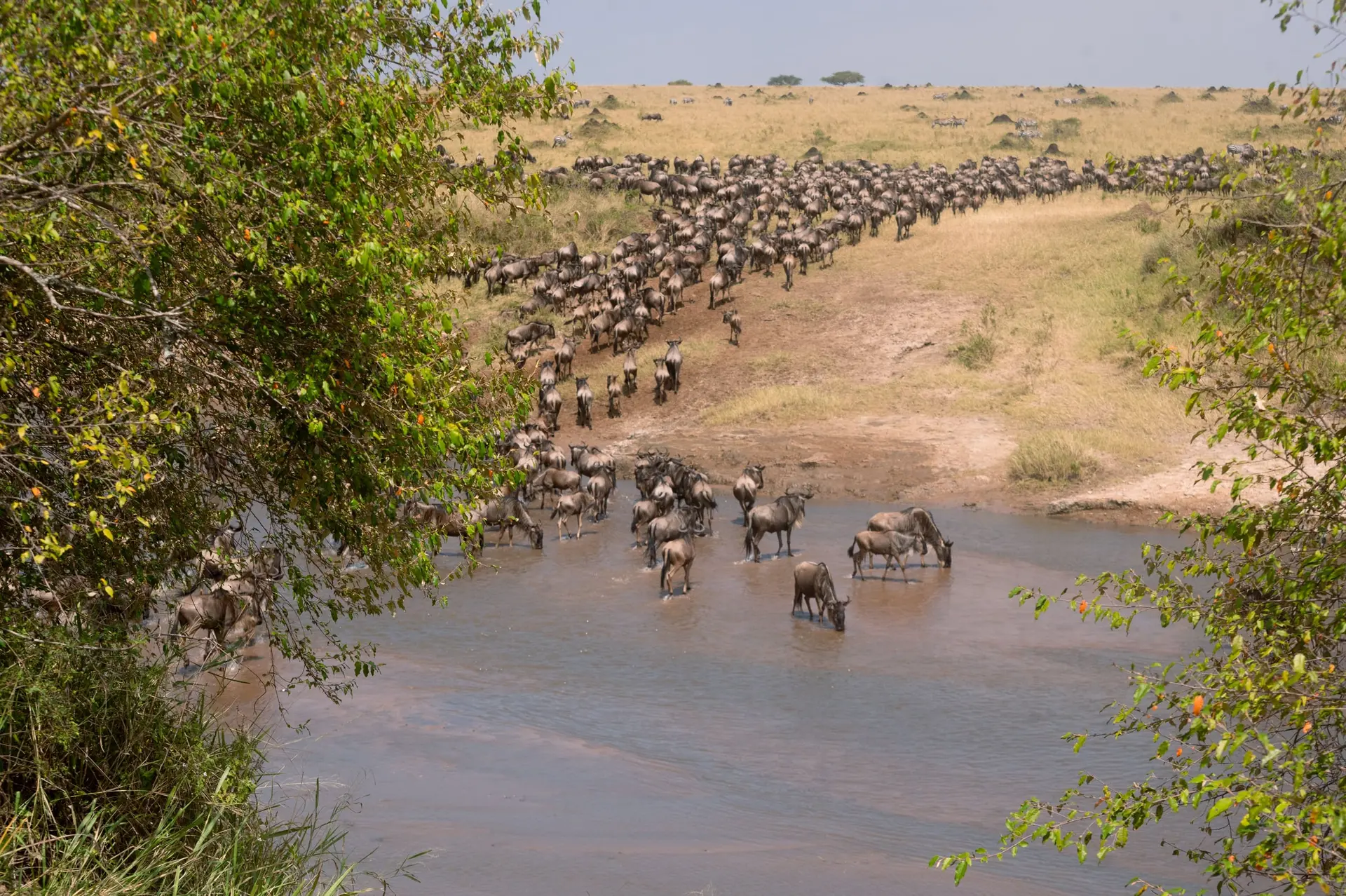
A September safari is very similar to August, with fewer vehicles. The herds are still on the Mara River at Kogatende and cross in both directions, sometimes north one morning and back south a few days later, and the crocodiles are still active. However, the August school holidays have ended, so a crossing that drew six to eight vehicles in August usually draws four to six in September. With some of the driest and clearest weather of the year and Tarangire's elephant herds at their peak, we recommend September to travellers who would like to see the crossings with fewer vehicles.
Wildlife Conditions in September by Park
Northern Serengeti (Kogatende / Lamai)
ExcellentThis is the peak of the crossing season. The herds cross the Mara River in both directions throughout the month, with crocodiles in the water and lions and cheetahs waiting on both banks. The Lamai Wedge, on the north bank, has far fewer vehicles. Late in the month the herds begin moving south.
Tarangire National Park
ExcellentIn the height of the dry season Tarangire is at its best, with large elephant herds along the river and the Silale Swamp drawing wildlife of every kind. Game viewing can compare with the Serengeti, with far fewer vehicles.
Ngorongoro Crater
ExcellentAt the height of the dry season the grass is short and visibility is excellent, with the resident black rhino and a very high density of large animals. The crater floor is busy, so we recommend going down when the gate opens.
Lake Manyara
ExcellentThe dry season is at its best here, with thin vegetation, wildlife at the lake and springs, tree-climbing lions in their most reliable period and large numbers of waterbirds.
Ndutu / Southern Serengeti
GoodDry and quiet, and away from the migration. The resident game is spread out, and you will see very few other vehicles.
September Week by Week
September 1-7
Best location: Kogatende / Lamai
The herds are spread across the northern Serengeti and the Mara, with several crossings possible each day, and fewer vehicles than in August.
September 8-14
Best location: Mara River, Kogatende and Lamai
In many years this is the peak of the crossings, with herds crossing back and forth as they follow local storms on both sides of the river.
September 15-21
Best location: Northern Serengeti toward Lobo
The first clear movement south. Crossings continue, but some herds begin moving towards Lobo.
September 22-30
Best location: Lobo / northern Serengeti
The move south speeds up, there are fewer crossings and fewer vehicles. We recommend a flexible plan rather than spending every night in the far north.
| Week | What's Happening | Best Location |
|---|---|---|
| September 1-7 | The herds are spread across the northern Serengeti and the Mara, with several crossings possible each day, and fewer vehicles than in August. | Kogatende / Lamai |
| September 8-14 | In many years this is the peak of the crossings, with herds crossing back and forth as they follow local storms on both sides of the river. | Mara River, Kogatende and Lamai |
| September 15-21 | The first clear movement south. Crossings continue, but some herds begin moving towards Lobo. | Northern Serengeti toward Lobo |
| September 22-30 | The move south speeds up, there are fewer crossings and fewer vehicles. We recommend a flexible plan rather than spending every night in the far north. | Lobo / northern Serengeti |
Tanzania Weather and Temperature in September
The temperature in Tanzania in September starts to rise after the cool months of June to August. Average highs are about 26 to 27°C in Arusha, Tarangire and the Serengeti and about 30°C on Zanzibar, while early mornings stay cool at around 13 to 15°C. September is one of the driest months of the year, with Tarangire averaging only about 2 mm of rain and Arusha the fewest rain days of any month. The table below sets out the Tanzania weather in September for each stop on a typical route.
| Location | Average high | Average low | Rainfall | Rain days |
|---|---|---|---|---|
| Arusha1,350 m above sea level | 26°C78°F | 13°C56°F | 10 mm | 3 |
| Tarangire1,180 m above sea level | 27°C81°F | 15°C59°F | 2 mm | 2 |
| Central Serengeti (Seronera)1,490 m above sea level | 27°C81°F | 14°C57°F | 34 mm | 6 |
| Northern Serengeti (Kogatende)1,510 m above sea level | 27°C81°F | 13°C55°F | 81 mm | 10 |
| Ngorongoro Crater rim2,280 m above sea level | 21°C71°F | 8°C47°F | 10 mm | 6 |
| Zanzibar18 m above sea level | 30°C87°F | 21°C70°F | 37 mm | 5 |
Long-term monthly averages. The mainland figures are 1961 to 1990 averages from the Climatic Research Unit climate grid, because we could not find published averages from a weather station inside the parks. The Zanzibar figures are the official 1991 to 2020 averages for the island's weather station. Rain days count days with at least 0.1 mm of rain on the mainland and at least 1 mm on Zanzibar. Sources are listed at the end of the page. The averages for every month are on our Tanzania weather by month page.
Early mornings and the middle of the day
Early morning game drives in September are cool, with an average low of about 13°C at Kogatende and 14°C at Seronera, and the warmth returns quickly after sunrise. The middle of the day is warmer than in July and August, and the dry air makes the sun feel strong, so a hat and sunscreen are important.
On the Ngorongoro Crater rim
The Ngorongoro rim is still cold at dawn in September, with an average low of about 8°C, and September is the driest month of the year on the rim, with about 10 mm of rain. The afternoon high of about 21°C makes the rim comfortable later in the day.
What to pack for September
For September we recommend a fleece for early drives and the rim, a light windproof layer, and lighter clothing than in July for the warmer afternoons. The tracks are dry and dusty, so we suggest a cover for your camera and a scarf or buff. Zanzibar is warm and fairly dry in September, which makes it a good month to finish a safari on the coast.
How the weather affects game viewing in September
September weather keeps the wildlife concentrated. In Tarangire the river is one of the few sources of water and the elephant herds reach their peak, while in the north the herds stay near the Mara River, where showers are more frequent than anywhere else on the circuit. The clear, dry air gives very good visibility on the open plains.
September vs August at the Mara River
For wildlife, August and September are very similar, with the herds at the Mara, crossings on most days somewhere along the river and plenty of predators. The main difference is the number of visitors. August is the peak of the school holidays in the northern hemisphere, and the main crossing points at Kogatende are busy. By the first week of September this eases, and the average number of vehicles at a crossing drops from six to eight to four to six, with the largest drop at the best-known crossing points.
September has two further advantages. The light is often the best of the year, with very dry air, little dust haze early in the month and golden grass, and there is more lodge availability than in August. Prices are much the same, as September is still peak season at most camps, and rates come down on October 1 at some camps and on November 1 at the rest. For the same price, September usually offers a quieter version of the same trip.
The Lamai Wedge
The Lamai Wedge is the triangle of land between the Mara River and the Kenyan border, on the north bank of the river, which most vehicles coming from the south do not reach.
From the Wedge you can watch the same crossings as from the southern bank, with far fewer vehicles, and move along the river when a herd changes its crossing point. The few camps in the area are small and are often fully booked most of a year ahead. If the crossings are the main reason for your trip and you would prefer to watch them with two other vehicles rather than eight, the Wedge is worth planning around. We recommend three nights there, followed by two nights in the central Serengeti for the resident big cats on the way south.
September Itineraries
Great Migration Safari
From $4,680 pp10 Days / 9 Nights
Northern Serengeti · Serengeti · Ngorongoro
Four nights at Kogatende for the crossings, the central Serengeti for the resident big cats and a full day in the crater on the way back. September is the best month for this route.
View Full Itinerary8-Day Classic Tanzania Safari
From $2,625 pp8 Days / 7 Nights
Tarangire · Serengeti · Ngorongoro
The peak of the dry season across the whole circuit, with large numbers of elephants in Tarangire. This is one of the best months for the classic route.
View Full ItineraryQuestions About a Tanzania Safari in September
Are the Mara River crossings still good in September?
Yes. In early and mid-September the crossings are often as frequent as in August, with noticeably fewer vehicles, usually around four to six at a crossing rather than six to eight. The herds are still large, the crocodiles are still active and the herds continue to cross back and forth throughout the month. Late September is also good, although the herds begin moving south and the far north gradually empties.
September or August: which is better?
The wildlife is much the same, but there are fewer visitors in September, with fewer vehicles at the crossing points, better lodge availability and often the best light of the year. August is the better choice mainly if your dates depend on school holidays. Both months are priced at peak rates, so we usually recommend September.
When do the crossings stop?
There is no fixed end date, as the herds follow the rain rather than the calendar. Crossings usually continue through September and into early or mid-October, then become occasional as the first rains in the south draw the herds back towards the calving grounds. In a year when the rains are late, crossings can continue well into October.
Where should I stay in September?
We recommend Kogatende in the northern Serengeti for the crossings, or the Lamai Wedge for quieter views from the north bank, combined with two nights in the central Serengeti for the resident big cats. The small camps in the north are often fully booked 9 to 12 months ahead for September, so we recommend planning early.
Is September cheaper than August?
Not significantly. Both months are peak season at most camps, and rates come down on October 1 at some camps and on November 1 at the rest. For the same price, September offers more availability and fewer vehicles. Our Great Migration Safari starts from $4,680 per person and the 8-day Classic from $2,625 per person, with park fees included.
What is the weather like in September?
September is one of the driest months of the year, with very little rain on most of the circuit, afternoon highs of about 26 to 27°C and cool dawns inland, when the Ngorongoro rim averages about 8°C at first light. The short, sparse grass and clear, dry air give the best visibility of the year. Please pack a warm layer for the morning game drives.
What else is at its best in September?
Tarangire is at its best, as the dry season brings very large elephant herds to the river and the Silale Swamp draws many other animals. The Ngorongoro Crater is also at its best, Lake Manyara's tree-climbing lions are in their most reliable period, and Zanzibar is in its dry season, which suits a beach extension.
Sources and Maintenance
Where these figures come from
The temperatures and rainfall in the weather table are long-term averages, and a single year can be wetter, drier, warmer or cooler. We could not find published long-term averages from a weather station inside the northern parks, so the park figures come from the Climatic Research Unit's global climate grid, which builds each grid cell of about 18 km from nearby station records and allows for altitude. The Zanzibar figures are the official 1991 to 2020 averages for the island's weather station. As a check, the official 1991 to 2020 averages for Kilimanjaro International Airport are about 1 to 2°C warmer by day than the grid figures for the same area, so please treat the daytime highs as slightly conservative.
- Climatic Research Unit, University of East Anglia: CRU CL v2.0 global climatology, 10-minute grid (New et al. 2002) (1961-1990 averages for the grid cells covering Arusha, Tarangire, Seronera, Ndutu, Kogatende, the Western Corridor and the Ngorongoro Crater rim and floor, read 24 November 2026)
- World Meteorological Organization 1991-2020 climate normals, Zanzibar station 63870 (published by NOAA NCEI) (average high, low, rainfall and days with 1 mm or more, read 24 November 2026)
- World Meteorological Organization 1991-2020 climate normals, Kilimanjaro International Airport station 63791 (published by NOAA NCEI) (used to cross-check the Arusha grid figures, read 24 November 2026)