Serengeti vs Maasai Mara for the migration
The Serengeti in Tanzania and the Maasai Mara in Kenya share the same wildebeest herds, which cross the border between them every year. The right choice depends far more on the month you travel than on the reserves themselves, so we recommend picking your month first, and then the side of the river.
In brief
Serengeti National Park covers 14,763 km² and the Maasai Mara National Reserve 1,530 km², so the Serengeti is more than nine times the size of the reserve. The migration herds spend around nine months of the year on the Tanzanian side, and from about December to June the main herds are only in Tanzania, on the calving plains around Ndutu, in the central Serengeti and in the Western Corridor.
From July to September the herds reach the Mara River, which runs through both reserves, and crossings can be seen on either side of the border. In those months both sides are a good choice, and the decision comes down to your route, how you reach the river and which other parks you would like to see on the same trip.
Our team plans safaris in northern Tanzania from Arusha. This guide sets out the months when the Serengeti is the clear choice and the months when either side works well.
The two reserves at a glance
The Mara River rises on the Mau Escarpment in Kenya and runs for about 395 km through the Maasai Mara and the Serengeti to Lake Victoria. Narok County's management plan for the reserve describes it as the main, and at times the only, dry-season water source for both reserves, which is why the herds gather on its banks from July onwards.
| Serengeti | Maasai Mara | |
|---|---|---|
| Country | Tanzania | Kenya |
| Protected area | Serengeti National Park | Maasai Mara National Reserve |
| Area | 14,763 km² | 1,530 km² |
| Managed by | Tanzania National Parks (TANAPA) | Narok County Government. The Mara Triangle, west of the Mara River, is run by the Mara Conservancy on the county's behalf |
| Main migration herds | Around nine months of the year | Usually from about July to September, varying with the rains |
| Calving season | Ndutu and the southern plains, from about January to March | No calving season, as the herds calve in Tanzania |
| Mara River crossings | Kogatende and the Lamai Wedge, northern Serengeti | Along the river through the reserve, in Central Mara and the Mara Triangle |
| Usual gateway | Arusha and Kilimanjaro International Airport (JRO) | Nairobi |
| Other parks on the same trip | Tarangire, Lake Manyara and the Ngorongoro Crater | Kenya's other parks and conservancies |
Where the herds are, month by month
The table shows the usual pattern. The migration follows the rain, so the timing can move by several weeks from one year to the next, and our Great Migration map by month shows each position on a map.
| Month | Where the herds are | Main herds in | Where we recommend staying |
|---|---|---|---|
| January | Ndutu and the southern Serengeti plains, with calving building through the month | Tanzania | Ndutu |
| February | Peak calving around Ndutu, with lion, cheetah and hyena hunting on the plains | Tanzania | Ndutu |
| March | Ndutu, then moving north-west toward Moru Kopjes | Tanzania | Ndutu early in the month, central Serengeti later |
| April | Central Serengeti, between Moru Kopjes and Seronera, in the long rains | Tanzania | Central Serengeti (Seronera) |
| May | Central Serengeti into the Western Corridor, with the rut under way | Tanzania | Central Serengeti or the Western Corridor |
| June | Western Corridor along the Grumeti River, with the first river crossings of the year | Tanzania | Western Corridor |
| July | Western Corridor north to the Mara River near Kogatende. The first Mara crossings come in early July in some years and from mid-July in others | Mostly Tanzania, with the first herds reaching Kenya in some years | Western Corridor early in the month, Kogatende later |
| August | On the Mara River around Kogatende and the Lamai Wedge, with part of the herd crossing into the Maasai Mara and back | Both sides of the border | Kogatende, for three nights or more |
| September | Crossings continue much as in August, in the driest weather of the year | Both sides of the border | Kogatende, for three nights or more |
| October | Crossings in the first part of the month, then moving south through Lobo and the eastern Serengeti | Both sides early in the month, then Tanzania | Kogatende until about 20 October, central Serengeti after |
| November | Eastern and central Serengeti, moving south with the short rains | Tanzania | Central Serengeti |
| December | Ndutu and the southern plains, ahead of the calving season | Tanzania | Ndutu |
The Maasai Mara migration: when to go and when to avoid
The Maasai Mara sees the migration for a shorter part of the year than the Serengeti, because the herds calve and spend the wet season in Tanzania. These are the three things to know before you choose the Kenyan side.
When the herds are in the Mara
Narok County's management plan for the reserve places the main migration in the Maasai Mara between July and September, when it mixes with a smaller migration that stays on the Kenyan side all year. August and September are the most reliable months for the Mara River crossings on either side of the border. For eight months of the year, from November to June, the main herds are only in Tanzania.
When to avoid it
For the migration, avoid roughly November to June. The long rains are the wettest time of year, and at Kogatende, on the Tanzanian side of the border, average rainfall peaks in April at 194 mm. In the high season the crossings draw crowds: the plan records more than 150 vehicles at a single crossing, which is one reason we recommend staying close to the river for several nights and reaching a crossing early.
The 12-hour rule
The Mara Conservancy, which runs the Mara Triangle for Narok County, states that its 12-hour park entry ticket is valid from 6:00 am to 6:00 pm on the day, whatever time you enter, and it does not carry over to the next day. A ticket bought in the early afternoon covers only the rest of that day. Terms for guests staying at camps inside the reserve can differ, so check them with your camp. Tanzanian park fees work differently, and ours are listed on the Tanzania park fees page.
The Mara River crossings on each side of the border
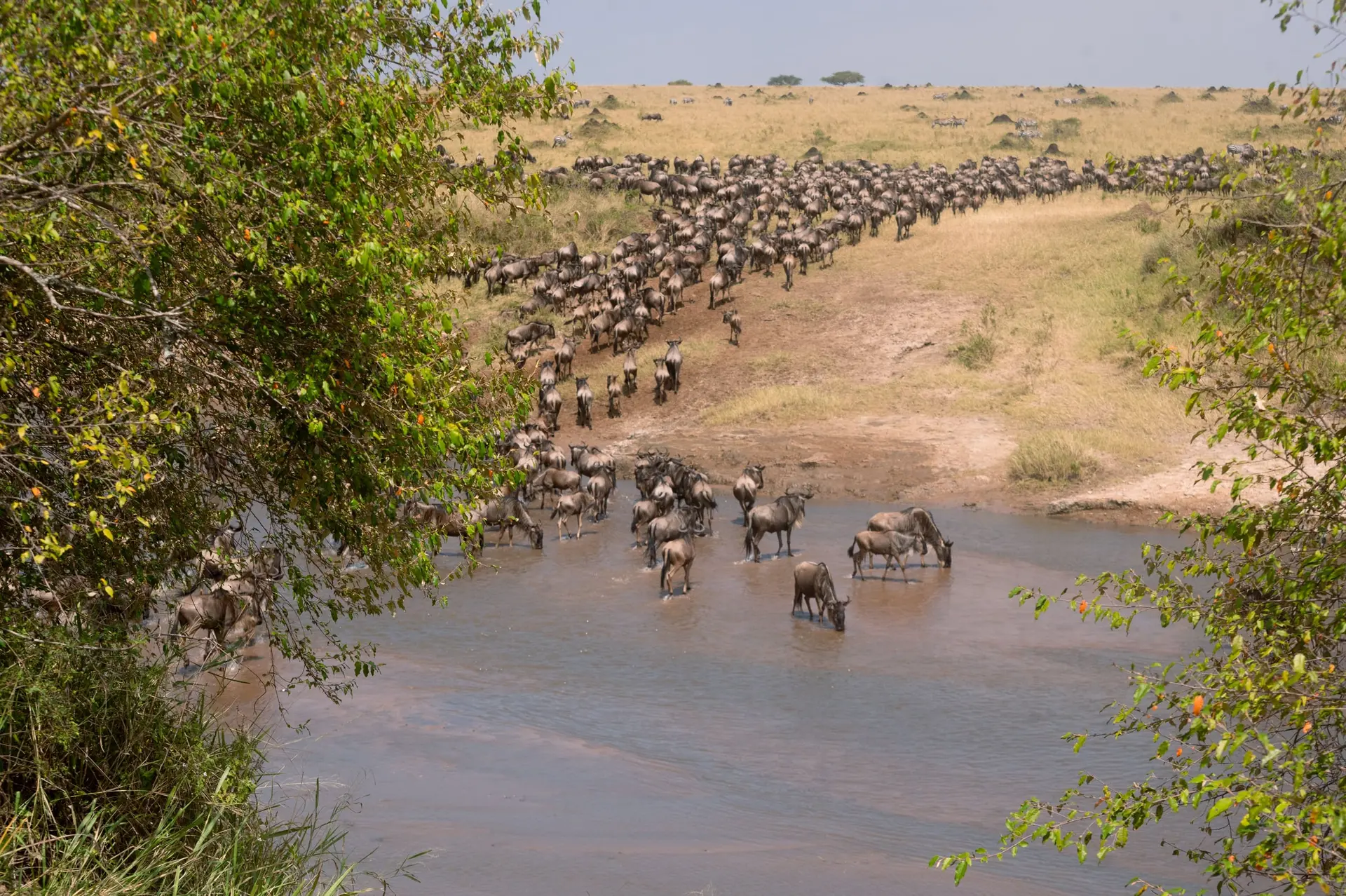
The same herds cross the Mara River in both directions, sometimes heading north one morning and back south a few days later, so a crossing seen from Tanzania and one seen from Kenya are part of the same event. What differs is where you stay and how you reach the river.
Kogatende, on the south bank in the northern Serengeti, is where most of the Tanzanian camps for the crossings are found, and it has its own airstrip. By road, the drive from Arusha to the central Serengeti takes 7 to 8.5 hours, and the onward drive from Seronera to Kogatende takes 4 to 5 hours, or 7 to 8 hours as a game drive, so on a shorter trip a flight to the north saves a long day on the road.
The Lamai Wedge is the triangle of Tanzanian land between the Mara River and the Kenyan border, on the north bank of the river. It looks onto the same crossing points from the other side and has fewer camps than the south bank. Our northern Serengeti guide covers both banks, and the Mara River crossing guide covers when and where the herds cross. On the Kenyan side, the river runs through the Maasai Mara National Reserve, between the Central Mara section to the east and the Mara Triangle to the west, which is reached from Nairobi.
Vehicles at the crossings
When a herd starts to cross, vehicles gather quickly on both sides of the border, and in August the best-known crossing points are busy in both countries. September is usually quieter than August, once the school holidays in Europe and North America have ended. A camp close to the river also helps, because it lets your guide reach a crossing early.
How long to stay
Herds often gather on the bank, approach the water several times and then turn back, so a crossing cannot be predicted to the hour. We recommend at least three nights close to the river, on whichever side you choose, as one or two nights is rarely enough.
How to choose by month
For most of the year the month decides the question for you, because the herds are only on one side of the border. The choice is open in August and September, and in parts of July and October.
December to March
Serengeti
The herds are on the short-grass plains around Ndutu for the calving season, so the Serengeti side is the only place to see the migration in these months. February is the peak of the calving, and predators hunt among the herds throughout.
April to June
Serengeti
The herds move through the central Serengeti into the Western Corridor, and the first river crossings take place on the Grumeti in June. April and May are the green season, when Tanzania's low-season park fees apply from 15 March to 15 May and the parks are at their quietest.
July
Serengeti
July is a month of transition, and the date the herds reach the Mara River changes from year to year. A route that starts in the Western Corridor or the central Serengeti and moves north as the herds arrive gives you a good chance of finding them in either case.
August and September
Either side
The herds are on the Mara River and cross in both directions, so crossings can be seen from Kogatende, the Lamai Wedge or the Kenyan side, and the best choice depends on your route. If you would also like to see the Ngorongoro Crater or Tarangire, the northern Serengeti fits into the same trip. If you are flying into Nairobi with only a few days, the Maasai Mara is the shorter journey.
October
Serengeti
Crossings continue in the first part of the month, and the herds then turn south through Lobo and the eastern Serengeti, back toward Tanzania's central plains. A plan that spends the first nights in the north and the later nights further south follows them.
November
Serengeti
The short rains draw the herds south through the eastern and central Serengeti toward Ndutu. The central Serengeti is good for predators in every month, so it makes a reliable base while the herds are on the move.
How to choose by trip length
On a short trip of three or four days, we recommend one reserve and one area within it. Outside the crossing season, the central Serengeti or Ndutu can be reached by road from Arusha, and our 5-day northern circuit from $1,815 per person combines Tarangire, the central Serengeti and the Ngorongoro Crater. For the crossings on a short trip, a flight to the northern Serengeti is the practical way to reach the river, and if you are flying into Nairobi with only a few days, the Maasai Mara is the shorter journey.
With a week, the Serengeti side adds the parks around it. Between January and March, the 7-day calving season safari from $2,640 per person spends three full days at Ndutu, with a half day in the Ngorongoro Crater on the way. In other months the 8-day classic safari from $2,625 per person covers Tarangire, the central Serengeti and the crater.
With ten days in the crossing season, the 10-day Great Migration safari from $4,680 per person gives you three full days on the Mara River at Kogatende, with the central Serengeti before and the Ngorongoro Crater after. If you would like a beach at the end, the 11-day Tanzania and Zanzibar trip from $3,350 per person adds three nights on the coast.
Combining the Serengeti and the Maasai Mara
Visiting both is possible, and it works best on a longer trip. Travel between the two countries runs through Nairobi and Arusha, by scheduled flight or by road through the Namanga border, and the drive from Nairobi to Arusha takes 4.5 to 6 hours, including the namanga border. Each country also has its own entry requirements, and our Tanzania visa guide covers the Tanzanian side.
On a trip of under ten days, we usually recommend choosing one side, because the travel day between the two countries comes out of your game drives, and the herds you see in the Mara in August are the same herds that cross at Kogatende. The Tanzanian side has the advantage of the other northern parks on the same road, including the Ngorongoro Crater and Tarangire, and of the calving season at Ndutu earlier in the year.
If you would like to see both, send us your dates and the number of days you have, and we will suggest a route.
Frequently asked questions
Is the Serengeti or the Maasai Mara better?
The answer depends on the month you travel. From about December to June the main migration herds are only in Tanzania, so the Serengeti is the better choice for those months. From July to September the herds are on the Mara River and crossings can be seen from both countries, so either side works and the best choice depends on your route. The Serengeti covers 14,763 km² and the Maasai Mara National Reserve 1,530 km², so the Serengeti offers more variety of habitat and more room to move away from other vehicles.
Are the Serengeti and the Maasai Mara the same place?
They are two reserves in one ecosystem, divided by the border between Tanzania and Kenya. The Serengeti is a national park in Tanzania, and the Maasai Mara National Reserve lies directly to the north in Kenya. The wildebeest move freely between the two, and the Mara River runs through both.
Is Kenya or Tanzania better for the Great Migration?
For most of the year, Tanzania. The main herds are only on the Tanzanian side in eight months of the year, including the calving season at Ndutu from December to March and the Grumeti River crossings in June. Narok County's management plan places the main migration in Kenya's Maasai Mara between July and September, and in August and September the Mara River crossings can be seen from both countries, so either side works. In those months, a Tanzania trip can add the Ngorongoro Crater and Tarangire on the same road, while the Maasai Mara is the shorter journey from Nairobi.
Which month is the Great Migration in Kenya?
The main herds are usually in Kenya's Maasai Mara between July and September, according to Narok County's management plan for the reserve, after crossing the Mara River from the northern Serengeti. August and September are the most reliable months, and the timing moves with the rains each year. From about October to June the main herds are on the Tanzanian side, in the Serengeti and around Ndutu. The plan also describes a smaller migration that stays in Kenya all year and mixes with the main herds in the reserve.
When should you avoid the Maasai Mara?
If the migration is your reason for going, avoid roughly November to June, when the main herds are in Tanzania. The long rains are the wettest time of year: at Kogatende, on the Tanzanian side of the border just south of the reserve, average rainfall peaks in April at 194 mm. The other thing to plan around is crowding at the crossings in the high season, when Narok County's management plan records more than 150 vehicles at a single crossing.
What is the 12-hour rule for the Maasai Mara?
It is the way park entry tickets are timed. The Mara Conservancy, which runs the Mara Triangle for Narok County, states that its 12-hour park entry ticket is valid from 6:00 am to 6:00 pm on the day, whatever time you enter, and it does not carry over to the next day. A ticket bought in the early afternoon therefore covers only the rest of that day. Terms for guests staying at camps inside the reserve can differ, so check them with your camp before you travel.
Where is the best place to see the Mara River crossings?
The crossings can be seen from both countries. On the Tanzanian side, the camps around Kogatende on the south bank and in the Lamai Wedge on the north bank are close to the main crossing points. On the Kenyan side, the river runs through the Maasai Mara National Reserve between Central Mara and the Mara Triangle. Crossings cannot be predicted to the hour, so we recommend at least three nights close to the river, wherever you stay.
How much bigger is the Serengeti than the Maasai Mara?
Serengeti National Park covers 14,763 km², and the Maasai Mara National Reserve covers 1,530 km² according to Narok County's management plan for the reserve, so the Serengeti is more than nine times the size of the reserve.
Can I visit the Serengeti and the Maasai Mara on one trip?
Yes, it is possible on a longer trip. Travel between the two runs through Nairobi and Arusha, either by road through the Namanga border, which takes 4.5 to 6 hours, including the namanga border, or by scheduled flight. On a trip of under ten days, we usually recommend choosing one side, as the travel day between the two countries comes out of your game drives.
Related pages
Great Migration map by month
Where the herds are in every month, with a map.
Serengeti National Park
The five zones, the wildlife and the best months.
Mara River crossing
When and where the herds cross, and where to stay.
Northern Serengeti
Kogatende, the Lamai Wedge and the crossing season.
Safari in August
The peak of the Mara River crossings, week by week.
Drive or fly between parks
When a flight to the northern Serengeti saves a day.
Sources and Maintenance
Where these figures come from
The area, management, river, migration-month and crossing figures for the Maasai Mara come from Narok County's management plan for the reserve, and the ticket rule from the Mara Conservancy. Herd positions are the usual pattern, which moves with the rains each year, and the advice on where to stay and how long is our own guidance from planning these routes.
- Maasai Mara National Reserve Management Plan 2023-32, Narok County Government (February 2023, read 26 November 2026: reserve area, the Mara Triangle, management, the Mara River, the migration in the reserve between July and September and vehicles at the crossings)
- Mara Conservancy, Mara Triangle conservation fees (the 12-hour park entry ticket, read 26 November 2026)
- Climatic Research Unit, University of East Anglia, CRU CL v2.0 (1961-1990 average rainfall for the Kogatende grid cell)
- Serengeti National Park, Tanzania National Parks (TANAPA) (park area 14,763 km²)
- Saleh Safaris migration calendar (operator observation, the same pattern as our Great Migration month-by-month guide)
Planning around the migration?
Tell us the month you can travel and how many days you have, and we will suggest where in the Serengeti to stay.